Subtle Sexism and the Complicity of Women by Christina Knowles

news.com.au
news.com.au

This week I was confronted with the fact that numerous girls from the age of 16-18 hold views of gender equality, or should I say inequality, that are more akin to what I expect from their male counterparts of the same age. I teach in a somewhat, okay, very conservative high school, but still, these students have embraced openly homosexual and transgendered students with fairly open arms. Yet these same students hold the view that women should be submissive to men, that it is a good idea to stay home and let husbands take care of them, and that many jobs traditionally held by men should continue to be held by men to the exclusion of women.

It seems that no matter how prevalent racism is, no matter how discrimination still subsists against the homosexual community, and no matter how much prejudice remains against those who practice certain religions or no religion at all, the final holdout will likely be biases based on gender. It makes me wonder with all the racist comments directed against our first black president, who happens at least to be a man, what kind of degradation will a future female president be made to endure. I have to ask myself, Why?

Well, here’s my theory. America is a country where, according to a Pew Research Poll (2012), 73% identify as Christian (PewResearch). And although sexism is a factor in many religions, including Judaism, I often hear many comments about Islam’s blatant sexism, which I don’t deny, but the sexism inherent in Christianity is a much more subtle, and therefore, easier to ignore type of oppression, and with 73% of Americans theoretically accepting the bible as God’s word, I wondered if this is the root of our tenacious American version of sexism.

Of course, the bible condemns homosexuality, and yet, there seems to be a trend to accept that as a lifestyle more and more. Still, being raised in the Christian religion myself, I know, firsthand, the views of women’s roles according to “God.” I have heard from the pulpit of at least a dozen churches that women are to be submissive to their husbands, should not rule over a man, that woman was made for man, women were created to be man’s helper, and that a woman is to keep the home, stay silent in church, and ask her husband if she has any questions.

Of course, all of this is biblical. This archaic message continues to be heard from thousands of pulpits today, even in the 21st century. It really is quite shocking—yet, many Americans aren’t shocked at all. Why?

I believe that women are complicit in their own sexist treatment as a result of being subtly conditioned by a predominantly Christian culture to find sexist treatment desirable, flattering, sexy, and even loving. Again, from the pulpit I’ve heard ridiculous explanations of the stories in the bible twisted to make the degradation of women seem acceptable. I’ve heard a pastor say that Adam only ate of the forbidden fruit because he didn’t want Eve to be condemned without him. Sure, that is a much more romantic way of blaming Eve for the downfall of mankind. And everyone’s heard the feel-good twist on the creation of Adam and Eve. The real bible story goes that Adam was created first, and then Eve was made from his rib to be his “helpmate” because it was “not good for man to be alone.” The modern version of this story is that Eve was taken from Adam’s rib to symbolize how she walks next to him—not in front of him, not behind him, but equal to him.

I guess someone should have told this version to Paul. This is what he has to say on the subject in I Timothy 2: 11-15: “Let a woman learn in silence with all submission. And I do not permit a woman to teach or to have authority over a man, but to be in silence. For Adam was formed first, then Eve. And Adam was not deceived, but the woman being deceived, fell into transgression. Nevertheless she will be saved in childbearing if they continue in faith, love, and holiness, with self-control” (Biblegateway.com). Apparently, Paul, and God by extrapolation, believe that because Eve came after Adam and was first to be deceived, women now and forever after must keep their mouths shut, be submissive, know their place in the church and at home, and if they do their job of birthing children, there may still be hope for them. So much for walking side by side in equality.

And, of course, there is always the “Chivalry” justification. I’ve heard from the pulpit that women, as the “weaker vessel” are to be treated like a priceless vase or precious fine china. They need the protection of a man, and this, unfortunately, means protecting them from doing really hard stuff like having authority over a man. Where was all this delicate treatment when women had to marry their rapists or were being offered up to be molested in the place of angels in Sodom and Gomorrah, by a man who was deemed “righteous” in God’s eyes? Naturally, there is an “explanation” for this as well.

Gotquestions.org is a popular site dedicated to answering the unanswerable questions and contradictions in the bible. This is what they have to say about Lot’s righteousness: “Based on what is revealed about Lot’s life, one might wonder if he was righteous. However, there is no doubt that God had declared him to be positionally righteous, even during his time in Sodom . . . At some point Lot had believed in the coming Messiah, and that faith resulted in a righteous standing before God. It is likely that Lot’s uncle, Abraham, had passed this truth down to him” (Gotquestions.org). So he was only considered righteous because he had once believed in the coming Messiah, which contradicts numerous teachings regarding apostates who “turn from the faith” and are commonly thought to never have been converted in the first place. My point is that our culture seems to accept every despicable treatment of women justified by religion as long as we sugarcoat it.

But the absolute craziest thing I’ve heard lately came from a conversation I had with a local bible guru who hosts a Christian radio question and answer show in Denver, Colorado. This talk show host actually used the “protection” reasoning to justify polygamy as being superior to homosexual marriage. Now, I’m sure he would deny that he was justifying polygamy. However, he claims that there are times and cultural demands that present polygamy as the only viable option for women to live safely and be protected. He says, for example, in the bible, that God allowed polygamy for the protection of women. He states that sometimes, in a certain culture where men hold the power and status, and there are not enough men to go around, women would be on the street without polygamy. He says it isn’t God’s ideal plan, but God allows it because the culture requires a redefinition of marriage. Yet he denies that we can redefine marriage to include same sex marriage based on our changing culture. It also seems the double-standard never works in favor of women because when I asked him if the reverse would be true—if a culture dominated by women existed, wherein women held the power, the status, the jobs, and there were fewer men than women, if women should have more than one husband to protect the men, he declined to answer, and instead, changed the subject.

It is no revelation that sexism is rooted in traditional religions. However, it is the subtle acceptance of this legitimatized sexism among mainstream and nice people that makes it so insidious and pervasive. According to a study published by Psychology of Women Quarterly, the effects of what psychologists, Burn and Busso, call Benevolent Sexism, wherein women are complicit in their own oppression due to the religious and cultural reframing of said oppression, biblical literalism is at the root of this problem. Burn and Busso find that their studies “do suggest that religiosity is correlated with BS [Benevolent Sexism]. Thus, a consideration of the various forces that contribute to women’s lower power and status should include religion. Religion is frequently a central part of a culture and many religions communicate to their followers that men’s greater power and status relative to women is appropriate and acceptable. Although this perspective is presented ‘benevolently’ rather than ‘hostilely,’ the net effect is still to support gender inequality—especially because women as well as men tend to endorse it. Not only does BS justify traditional gender roles but it also pacifies women’s resistance to gender subordination by masking gender inequality with the cloak of chivalry (e.g., men need women and should protect and cherish them” (Glick & Fiske, 2001a, 2001b). “BS rooted in religion may be a significant obstacle to gender equality when it is rooted in literal scriptural interpretations and is essentially nonfalsifiable because there is no arguing with the word of God” (Burn, Busso, p.6). Burn and Busso quote Anwar’s 1999 study “Theological alternatives to religious fundamentalism” that states “common features of religious fundamentalism include a belief that society needs to be rescued from secularism, a commitment to the authority of the ancient scriptures, and the idealization of a past where gender spheres were separate and women were modest and subordinate” (Anwar, qtd in Burn and Busso, p. 1).

The churches I grew up in and have attended at various points throughout my life claim not to be fundamentalist, just bible-believing, but they would all fit the above criteria. I don’t deny that there are many factors involved in the lingering and acceptable sexism persistent in the American culture besides religious justification and the “dressing up” of gender stereotyping and behavior. However, I do believe that a culture that teaches women that it is God who demands a subordinate role, and that this role is righteous and good, will continue the “benevolent” oppression of women, and that this acceptable oppression will not confine itself to benevolent acts and innocuous sexist views of women, if there is such a thing. As our culture moves beyond stereotypical assignments of roles to various people groups, the advancement of women as equal human partners in the modern world requires an abandoning of this acceptance of literal interpretations of the bible and of the adherence to ancient biblical writings as divine law that should be imposed on a modern society. As long as religious leaders use the divinity of scripture as justification for the subordinate treatment of women, effectively blaming God for their prejudice, and as long as they condition and pressure women to accept this treatment as the will of God, gender inequality will continue to exist in our society.

If, indeed, there is a god, I am sure this god is very disturbed at the thought of men using an ancient book written by men as a justification to inflate themselves and to persecute half of creation in his . . . or her name. –Christina Knowles

Sources:

Burn, Shawn Meghan, and Julia Busso. “AMBIVALENT SEXISM, SCRIPTURAL LITERALISM, AND RELIGIOSITY.” Psychology of Women Quarterly 29.4 (2005): 412-18. Digital Commons @ CAL POLY. Web. 6 Mar. 2015. <http://digitalcommons.calpoly.edu/psycd_fac/32/&gt;.

Gotquestions.org. Web. 6 Mar. 2015. <http://www.gotquestions.org/Lots-daughters.html&gt;.

“Nones on the Rise.” Pew Research Center. 9 Oct. 2012. Web. 6 Mar. 2015. <http://www.pewforum.org/2012/10/09/nones-on-the-rise/&gt;.

“I Timothy 2:11-15.” Biblegateway.com. New King James Version. Web. 6 Mar. 2015.

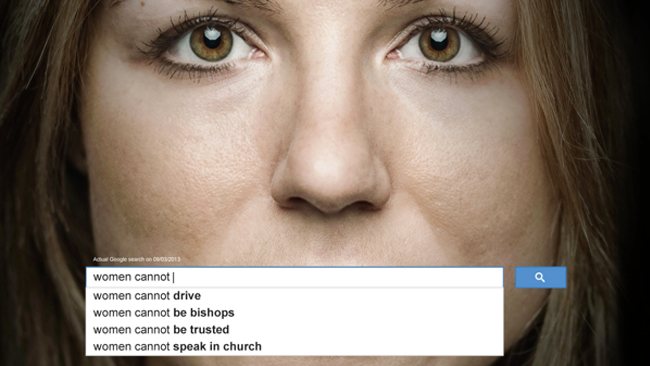
“UN Women Ads Show Sexism behind Google Searches.” Photo. News.com.au 20 Oct. 2013. Web. 7 Mar. 2015.

The Illuminating Task of House-Naming by Christina Knowles

SunflowerRecently, my husband, Randy, and I decided our house needed a name. Why not? After all, lots of homes have names: Tara, Downton Abbey aka Highclere Castle, Wuthering Heights, Pemberly, and, of course, Manderley, to name a few. But we don’t live in a castle, a plantation house, or a seaside mansion, so why does our house need a name?

The British seem to have started this tradition of house-naming when wealthy landowners named their manor houses, country homes, and castles. However, the idea caught on and quickly spread through the middle classes and commoners. Before house numbers as addresses, there were house names. So it is not completely without precedent that my husband and I decided that our simple, middle class home of the past six and a half years should finally be given a proper title.

This seemed a simple enough task—but that was before I realized that there is a certain psychology behind the naming of one’s home. There really is, at least, this is my theory. I sat down to make a list of choices. I thought I would come up with some ideas, show them to Randy, and we would eliminate the ones on which we could not agree, compromise, and choose one which we both liked. Simple.

As soon as I started my list, suddenly it seemed so important to get it right. I mean, we couldn’t go around calling our house something ridiculous like Shady Acres or ostentatious like Knowles Manor. It would be embarrassing. The name should reflect who we are and the way we like to live.Hollyhocks2

That’s when I realized that naming has a lot to do with psychology, and, in fact, the house we choose to live in and the way we decorate it reflects what’s important to us, who we are, or how we want to depict ourselves to others. More than just reflecting it, it reinforces what’s important to us, and what we want to focus upon.

Think about it. Is your house sparse with a large piece of exercise equipment in the living room, or a bike parked in the dining room? Is it elegant and aloof? Is it warm and cozy? Inviting? Covered to the ceiling in art? Filled with souvenirs of adventures and maps covered in pushpins? Is it sleek and modern? Tasteful?

My husband and I are homebodies. He is a musician, a composer, and I am a writer and an artist. Our house reflects our lifestyle. It’s on the small side, warm and cozy. It’s filled with books, art to the ceiling, and music gear everywhere. It has comfy furniture, a fireplace, and lots of fuzzy blankets. Outside, there are flower and herb gardens, vegetable gardens and berry bushes. There are stone paths and wild flowers. We like to spend time at home, and our home reflects this. Our home reflects us. We couldn’t just name it anything. Talk about first world problems.

Nothing seemed right. Still, I made a list:                    Chacho

  • Serenity Hall
  • Haven Hall
  • Meadow Muse
  • Artist’s Haven
  • Melody Muse
  • Poet’s Haven
  • Peaceful Gardens
  • Hollyhock Chalet

I ran them by Randy. “Hall” was pretentious and implied big. He also wanted to eliminate anything that was specific to just one of us, so we struck from the list anything to do with music, art, or poetry. So, we ended up with this:

  • Hollyhock Cottage
  • Hollyhock Chalet
  • Hollyhock Place
  • Meadow Muse
  • Serenity Cottage
  • Serenity Haven

We couldn’t make a decision of this importance quickly, so we waited. The more time that went by, the more the name Hollyhock began to resonate with me. In the summer time, we have huge hollyhocks that tower over our fence. They grow beautiful and huge each year, and every summer they seem to bloom in different vibrant colors than the year before. Also, our house reminds me of an English cottage on the outside, so finally, we chose Hollyhock Cottage as our home’s name, and this summer we plan to plant hollyhocks in the front yard and put our house’s name on a little sign.

HollyhocksIt was Hollyhock Cottage that said what we wanted it to about us—a simple cottage with a beautiful wild flower that grows enthusiastically and strong, even with little pampering. It stands up proud and tall, but is not grandiose. It’s a little ragged around the edges, but still lovely. It’s tenacious. Hollyhocks last all summer and struggle to survive even after the first snow falls. It comes back new and resilient every year. Just like us.

It reminds us that we are regular people with extraordinary dreams; we have purpose, we are persistent, and we ardently embrace each season of our lives. So, in the end, naming our house was astonishingly difficult and strangely enlightening. I highly recommend it.—Christina Knowles

10 Mind-Bending Epiphanies That Changed My Life by Christina Knowles

epiphany1) I’ll never be all caught up. Getting caught up in getting caught up is like a hamster running in a wheel. It’s pointless, so stop trying so hard. Now I make a few daily goals, but getting done with everything is no longer on the list. Knowing it is impossible sets me free to just stop and relax once in a while.

2) Pain is our friend. Whether it is physical pain or emotional pain, it is a signal that we need to do something different. It is the catalyst for change. Embrace it.

3) To some extent, you are already doing what you want to do, or you wouldn’t be doing it. Let’s be honest for a second. We can’t make ourselves do anything we don’t want to do for any length of time. Otherwise, we’d all be thin, healthy, and adept at meditation. So, the fact that I’ve been a teacher for 15 years must mean that some part of me actually wants to be a teacher. The same is true for all the rest of my habitual behavior.

4) I’ve believed lies most of my life, but because of this, I don’t know if my current beliefs are also lies. We grow up listening to and believing everything our parents or authority figures tell us. Then we find out that much of what we learned and believed is not true. We read, discover, and form our own ideas and teach them to other people who grow up and realize that much of what we taught them is not true. Who really knows the truth?

5) Marriage doesn’t have to be work, and shouldn’t be. People who tell you how hard marriage is and how much effort you have to put into it have bad marriages, so don’t listen to anything they say. Who would want to be married if it made your life more difficult? Evolutionarily speaking, the whole point of marriage is to make life easier. Don’t fight nature. Marry someone who is easy to be married to.

6) You don’t have to worry—I’m serious, you really don’t. Worrying is a choice. Sometimes we unconsciously begin to worry, but as soon as we realize we’re doing it, we can choose to stop. I know it’s cliché, but worrying never changed anything except your mood and physical health for the worse. There’s no point, and I’m too busy for pointless things. Whenever I start to worry, I allow myself to imagine the worse thing that can happen. It’s pretty ridiculous and funny, so it snaps me out of worrying pretty quickly, which leads me to number 7.

7) The only people who are stressed are people who care too much. I love the saying, “I don’t know about my bucket list, but my fucket list is getting pretty long.” The quickest way to stress-free living is shockingly not meditation—I’ve tried that. It’s saying, “Fuck it.” If something is going to cause my stomach to turn to knots, I realize that it must be something over which I have very little control, so I choose to not care about it anymore. I realize this is not possible in every case, especially when it comes to the health of loved ones, but as I understand number 6, there’s nothing I can do about it anyway.

8) We can love or hate anyone, regardless of what they are like. Almost 50 years of life has taught me that loving or hating someone is more about me than it is about them. I have learned that I am capable of loving the most unlovable person once I learn enough about them to understand their perspectives, what made them like they are, what is important to them, what they fear and for what they hope, and see them as they see themselves. Conversely, I can despise wonderful people if I choose to see them only through their faults, mistakes, or little annoyances.

9) Everyone is mentally ill, but then mental illness is normal, so no one is mentally ill. It seems like everyone has some sort of neuroses, depression, or anxiety today, so much so, that it’s hard to find someone who is not depressed, bi-polar, who does not have OCD, ADHD, addictive behavior, or some nervous disorder. It’s like allergies. Almost everyone has one. So doesn’t that make it the norm? And if it’s normal to have these brain malfunctions, then are they malfunctions? I’m not talking about serial killers here—serious sociopaths. I’m speaking of all the little idiosyncrasies that are now so common. Didn’t we always have them? We just didn’t label them and medicate them in the past. Get over it; you’re normal.

10) Death is not a big deal to the person who is dead. As a person who has serious doubts about the existence of an afterlife, I’m not worried about it. When I’m dead, I won’t know it, so what’s the big deal? Bury me, cremate me, throw me in a ditch. Who cares? I’m not there anymore. Sure, my life will be over along with all my potential, all my hopes and dreams, but again, I won’t know it, so what’s all the fuss about?

11) We choose friends in whom we see what we like about ourselves. People say that when we dislike something in another person, we are really seeing something in them which is negative about ourselves. I don’t know if that’s true, but the converse is most assuredly true. We really do choose friends in whom we see what we like about ourselves. We like them because we have these things in common, and because of them, we notice the best in ourselves.

12) People continue to lie when the best thing in the world is to be known, known by self and others, truly known. In an effort to be accepted, they never can be, and they are subconsciously preventing their own happiness.

Yes, I can count. I said there were 10 epiphanies that changed my life, but then I wrote 12. Well, as a person about to turn 50, I refuse to be constrained by a number. I am a rebel, and 10 sounded better than 12 in the title. But seriously, when I realized each one of these things, it changed my whole outlook on life, for the better, I’d like to think. So mind-bending? Yes, whenever my worldview shifts and things become clear and my life changes as a result, I consider my mind bent. —Christina Knowles

Photo courtesy of cloudfront.net

Peaceful Harbor by Christina Knowles

Lighthouse

To Randy–You are my peaceful harbor.

“Peaceful Harbor”

Through the briny deep, a charter

Struggles in the swell

Until it finds a peaceful harbor

The unbounded crest beats harder

In the distance rings a knell

Through the briny deep, a charter

A cargo of hopes to martyr

In the distance, a chance to quell

For it will find a peaceful harbor

Drifting farther

To a tranquil berth to dwell

Through the briny deep, a charter

With the Fates, will hope to barter

A ponderous destiny to compel

It to that sweet and peaceful harbor

Forecasts presume gales much larger

But Fortune’s will is to propel

It through the briny deep, a charter

Until it finds its peaceful harbor

—Christina Knowles (2015)

Photo courtesy of thedailymail.com UK

The Politically Correct Death of Intellect by Christina Knowles

Tanner Friedman Blog

I consider myself an open-minded person who values diversity and respects the feelings of others, but I am beyond annoyed at today’s expectation that we must filter everything we say through a screen of politically correct speech. This concept emerged from good intentions—the idea that we should treat others with differing ideologies, lifestyles, and religions with respect. Not necessarily respect for the beliefs, but respect for the person. But it has grown from an innocuous courtesy into full-blown censorship, an inability to engage in intellectual debate that muffles free expression and reduces communication to near meaningless small talk. Politically correct censorship is one more nail in the coffin of intelligent civil discourse. I fear the death of civil discourse will also be the death of critical thinking.

Take our public schools for example. The primary job of a teacher is to guide students through the process of learning, and that begins with critical thinking. But nowhere else is critical thinking stifled more than in the public school classroom. We have a million rules against it, beginning with “Don’t offend anyone,” “Don’t discuss anything potentially volatile,” and “Respect everyone’s beliefs.” I’m all for trying not to offend people, and I think we should always respect each other, but our definition of respecting beliefs has become an insistence upon accepting all as equally valid, regardless of how they may be based in ignorance or logical fallacy.

Before anyone misunderstands, let me say that I am not suggesting we disparage a person’s faith, cultural norms, or political ideologies, nor am I suggesting that we try to change them. I’m simply asking what happened to good old fashioned discussion? We seem to be going through an age of anti-intellectualism that is resulting in the dumbing down of our youth. Sure, they know how to play nice, but can they think? In my opinion, we are discouraging independent, critical thought, and unbelievably, they are going along with it.

I have always encouraged students to voice their opinions freely in my class. I have never considered it wrong or inappropriate for students to educate me and the rest of the class on aspects of their religion, regardless of which religion it is. I have enjoyed hearing their political evaluations, their suggestions for change, and listened respectfully to their views on just about every subject. My students have always felt safe doing this, knowing they would not suffer any negative recriminations for whatever their thoughts were or how they may differ from mine or anyone else’s in the class.

I’ve let students write on their experiences of coming out of the closet as homosexuals. I’ve let a student recount a beautiful memory of a childhood Ramadan celebration. I’ve welcomed students’ presentations on heroes of their faith, Christian missionaries who were martyred for their beliefs, and I’ve allowed students to do book presentations on everything from the Bible to the Wiccan Rede. I cannot fathom how talking about what you believe can hurt anyone, at least short of hate speech. I would not allow any speech that sought to single out for criticism a specific group or disparage another people, so I guess I do believe in some censorship, but the expectations of self-censorship is reaching levels of hilarity, except I’m not laughing. I’m afraid.

This year, for the first time in my teaching career, my classroom debates were a complete disaster. Why? Not because someone said something offensive, hateful, or shocking, but because students were so overly concerned with political correctness that they would barely speak at all. They hedged around every issue, and when their opposition posed a blatant fallacy, in some cases completely wrong information, the opposing team would not point it out. And I know they noticed it, but they would simply change the subject rather than critically discuss an issue.

This generation has been conditioned since their early childhood to be nice, respect all beliefs, and not rock the boat so much so that they are almost incapable of confronting an illogical argument on a topic for fear of offending a classmate. Perhaps, you may think this is a good thing. Well, I don’t believe it is good for anyone.

First of all, we should all have our ideas challenged. It’s good for us. For one thing, we need to know how to defend what we think. Defending our ideas helps us to define why we believe what we do, to look at our beliefs critically, and to see if they stand up to scrutiny. If they do, this only makes us stronger in our beliefs. Additionally, it teaches us how to defend our beliefs logically to others, rather than relying on fallacious arguments. But possibly most important is the growth we attain in our ability to think, judge, and to avoid being fooled by Machiavellian word play. Finally, we learn to communicate effectively—listening, synthesizing, analyzing, and evaluating first, and then returning discourse in an intelligent way that seeks common ground, or at least understanding rather than manipulation. But most of all, when we learn how to confront flawed arguments, we aren’t stifling our reasoning to passively sit in agreement with whatever enters our ear, quietly feigning acceptance.

Everyone needs to learn to evaluate the validity of ideas for themselves without fear of upsetting someone simply for disagreeing. It seems like today, we aren’t allowed to have differing opinions that deviate from the popular view, but instead of fearing attack or retaliation, we fear upsetting someone. Should that really be so devastating? What’s wrong with a little healthy disagreement? We seem to consider every oppositional comment hate speech.

The other day in class, I literally had to stop the conversation and change the topic three times because students were afraid to discuss a topic or point out glaring logical fallacies. In AP Language, one of our main learning objectives is to understand rhetoric, identify claims, appeals, and fallacies, and to counter them with sound reasoning and solid support. Try to teach that in a classroom where everyone is afraid to point out that a girl’s facts are in error when she stated, “The majority of scientists believe the earth was created in seven days because they’ve proven this to be true, while evolution is just a theory; therefore, only creation science should be taught in school,” or another one who said, “Just because the right to bear arms is guaranteed in the Constitution doesn’t mean we can have guns now. Those rules are out of date.” Another stated that everyone would rather play video games than read books, so teaching literature in school should no longer be required. Not one student had the nerve to call these students out on their lack of factual information or ludicrous logic. The class just sat there in stunned silence until the group moderator suggested moving on to the next topic.

I sat there in dumbfounded silence because the only thing going through my mind was that intellectual thought had just died, right there in front me, all because we have been conditioned to think that it is taboo to say, “Wait, that makes no sense,” or “I believe your facts are in error.” Why? Because it would be seen as attacking religious or political beliefs when, in fact, it is merely confronting an invalid justification. We see this in the general public’s avoidance of mentioning the word “Islam” in the same sentence as terrorist, as if we are somehow embarrassed for law abiding Muslims, which has the effect of an artificial non-communication dynamic that, instead of solving problems, only hides them, and I fear, has a much more insidious result. We have become our own thought police, co-conspirators in our own re-education, creating a Newspeak to prevent saying what we really think, and in the process, killing our critical thinking skills.

I think we all need to toughen up a little. Go ahead and disagree with me. I can take it.—Christina Knowles

Revival: The Death of Hope by Christina Knowles

RevivalRevival by Stephen King Book Review**SERIOUS SPOILERS**

Revival is one of the most original books I have ever read–a strange statement about a book, which King admits was inspired and influenced by some of his favorite horror authors. Among these are Arthur Machen, HP Lovecraft, and Mary Shelley. Still, I’ve read a lot of King, and this one seemed particularly unique. Although unlike his novels, it did seem rather like a return to his earlier writing in a way. But I’ll get to that. First, a synopsis.

Revival (a brilliant and apt title, by the way) opens with a reflection of the “cast” of characters that make up a person’s life and a bleak foreshadowing of the impact of Reverend Charles Daniel Jacobs, the “fifth business” or “change agent” in the fifty-some year span of the life of our protagonist, Jamie Morton. Already I know this book is going to deal with some heavy issues.

The next scene is strangely creepy even though nothing unusual or bad really happens, but that is how King plays this tale—very subtle, at least until the last fifty pages of the book. Anyway, the scene opens with six-year old Jamie playing with his toy soldiers in the dirt when a shadow falls over him in the form of Reverend Charles Jacobs. I remember being tense through this scene, expecting something to happen, but Jacobs is a just a kind and warm person.

From this point on, we get to see Jamie grow up. We experience his childhood problems with siblings, school, we see his first kiss, watch him discover his passion for music, agonize over his descent into drug addiction, and breathe a sigh of relief when he is cured of it. Jacobs, on the other hand, we see only through Jamie’s eyes: a kind and understanding pastor, a friend, a healer, a loving and devoted husband and father—until a tragic and senseless car accident gruesomely takes the lives of his wife and young son. But that’s one of the first themes explored in this novel. Aren’t tragic accidents always senseless? I mean, when do they ever make sense? Reverend Jacobs cannot make sense of it either, and as a result, he loses his faith and takes Jamie’s along with it, then turns full-time to his obsessive hobby of experimenting with electricity.

Without going into too much detail, time goes by and Jamie meets up with the reverend as an adult with a slightly less than positive result. At this point in the story “something happens,” tying Jamie irrevocably to Jacobs. The “something happened” repeated throughout the story was another inexplicably creepy device King brilliantly used.

Later Reverend Jacobs becomes an atypical traveling healer, complete with a revival tent and offering plate, furthering the not-so-subtle but oh-so-apt commentary on organized religion. Jacobs serendipitously meets up with Jamie several times throughout his life, each time having a more negative effect. Our opinion of Jacobs, sadly, spirals downward along with Jamie’s feelings for the pastor until, finally, the friendship deteriorates into complete loathing and disgust, at least on Jamie’s side.

The first three hundred and fifty pages of this novel are fresh, descriptive, and thought-provoking. The characters are realistic and well-developed. I loved Jamie–and Jacobs, which made me feel strangely like I was betrayed by the reverend as much as Jamie was. However, the next fifty pages descends into a parody-like ridiculousness that made me feel like I was watching an old cartoon version of Frankenstein.

Throughout the novel, the allusions to Mary Shelley’s Frankenstein; Or, the Modern Prometheus were obvious. The object of Jacobs’ last experiment is named Mary Fay, daughter of Franklin Fay and Janice Shelley. She has a son named Victor (as in Victor Frankenstein), he is obsessed with power, particularly electricity and with what happens to us when we die. You don’t have to be a brain donor to predict what’s going to happen next.

Although I certainly appreciate King’s attempt to pay homage to Shelley’s Frankenstein, it was so over-the-top that I could not help picturing one of the old movie versions of it complete with Victor Frankenstein screaming, “It’s alive!” while I read. Still, I knew to expect the classic horror to appear sometime in the book. In fact, I looked forward to it, just to be disappointed in its cartoonish nature—but possibly, that is just a matter of taste. After all, King was a fan of the graphic novel, so maybe this was on purpose. He is such a brilliant writer; it likely was intentional. The contrast between the realistic and effective social and religious criticism and the fantastically surreal ravings of a mad scientist were a little disorienting, but perhaps, that was the point. My real disappointment lay elsewhere.

My only true disappointment in this novel was in the last few pages. I guess I didn’t expect it to end on such a depressing note, but here I am complaining about being surprised when a moment ago I complained of guessing the end. I’ve been lulled into believing that King usually has a hopeful ending to his novels with good winning out over evil, at least for the moment. But this novel is much more like some of his early short stories that end in complete and utter despair. The most horrifying part of this novel is when all hope is dead, and Jamie realizes that there is something much worse than nothing at the end of this life, something inescapable and that salvation does not exist.

I’m not really a happy-ending kind of girl, but the depth of darkness at the end of this novel left me disturbed, and not in a fun horror kind of way, but in a hopeless, bitter kind of way. But maybe that’s the true mark of horror, being forced to face the ultimate fear—that there may be something even worse than the unknown. 4 out of 5 stars.—Christina Knowles

“Dinner Party Queen” by Christina Knowles

cocktail-partyEntering your enormous and lovely apartment,

you greet me with your gratuitous smile,

your plastic-flower image, and oh-so-courteous temperament.

You taunt me with your high-styled manners

and your generous remarks snub me as they normally do.

“How do you take your Beluga?” and “Which wine do you prefer?”

and “Oh, I didn’t mean to assume—I’ll be happy to select for you.”

You quickly explain to all of your friends

my regrettable shortcomings and beg them to forgive

my sinful lack of politesse, and then

politely excuse yourself and float across the room,

leaving me blundering in your cultural forum.

As I bitterly gaze at your perfect state,

your fashionable clothing gaily stabs me in the back—

your mission in life, so-to-speak.

Crimson faced, I hate to admit

your silky silhouette does look stupendous

in your A-line frock and jacaranda dyed heels.

I would never say it conflicts with your artistically painted face,

contrasting so vibrantly your pale complexion.

Bullhorn-bright and swelling with pride,

you sweep through the room, bulldozing my dignity

with your swanky attire and arrogant demeanor.

Slowly, I slide away from the circle of beautiful people

and fade into the paisley wallpaper,

which, I might add, is out of style.

Here I blend

Again, I gaze in your direction,

your elegant coiffure turns up its nose at my violin-string hair.

Mortified, I hide

humbly in the corner reserved for shopping school dropouts.

Slouching behind your ornate décor,

I look down at my flower-flocked frock and Payless shoes,

and ponder my sanity—why did I come?

I really must control these masochistic tendencies.

Swallowing down my caustic remorse; emerging

I slither my worm body over to your graceful self

and settle at your satin shoes.

Weakly, I rise up through the ashes of my incinerated pride

and face your rude disposition.

“Although it’s been so lovely, I really must be going,”

I croak as I meet your captivating blue eyes with my insipid ones.

“Before dinner? Oh well, if you must,”

you drawl so gallantly, perceiving your work is complete,

and I may again return to my hovel, properly placed.

Recognizing the dominance of your station, I retreat.

Backing down from the challenge, I fall into line

at the prosaic end of the pecking order.

There really was never any debate.–Christina Knowles

Image from laplayaclub.com

“The Clock’s Unwound” by Christina Knowles

Image from www.zazzle.com
Image from http://www.zazzle.com


The clock winds down

And it don’t care

And it doesn’t share

It strikes them down

It doesn’t bear

The slightest signs of life down there


The shot rings out

And it burns right through

The waterspout

And the spider turns off the flood

It ain’t no drought


She spurts her web right on out

It don’t hurt

The bottom feeder is out

And he don’t flirt

He comes right out

And takes your shirt

Right off your back

No time to shout


So the clock winds down

And you don’t care

What’s done is done

And you don’t dare

Interrupt the song

Disturb the lair

Let it be

Just move along

Until the clock’s unwound (Christina Knowles 2010)

How To Be Happy by Christina Knowles

Snagged from fastcompany.com
Snagged from fast company.com

As we start a new year, most of are thinking of new beginnings, fresh starts, or making changes of some kind. Why? Most of us just want to be happy. That got me to thinking about the times I have been really happy, and what makes the difference between those times and times of discontent. I noticed some things, many of which you may already do, and others you may want to try. As for me, I’m going to remind myself of these often.

  1. Don’t get upset at insignificant things; save your anger for righteous causes: Most things don’t really merit the damaging side-effects of anger. Learn to blow things off, unless they truly deserve anger. Righteous anger over injustice or cruelty can make a difference in the world. If it isn’t going to make a positive difference in the world, let it go. One way to mitigate anger is to change your perspective by putting yourself into the metaphorical shoes of the people making you angry. When you understand where someone is coming from and what motivates him, it’s a lot easier to let go of anger.
  2. Do something nice for someone when it is completely not your responsibility: A generous act of kindness means the most to others and to you when you know that doing it is in no way your responsibility. Cooking dinner when it’s your turn—you’re supposed to do that. Cook dinner when it’s someone else’s turn, and it means something. It also creates a pleasant feeling. But make sure you do not expect or even want something in return. That kind of destroys the whole concept.
  3. Be grateful for what you have. The old saying goes: “It’s not getting what you want; it’s wanting what you get.” It’s so easy to be discontent when you think of all that you need or would like to have—even non-material things like a relationship or more time. Try to stop yourself when you think of these things and focus on what you now have that you didn’t have before. Notice how far you’ve come and realize you will probably have those things someday anyway.
  4. See yourself as a member of a community: Everyone needs to feel like she belongs to something bigger than herself. For some this is a church family; for others it is a local charitable organization. Still others join book clubs or Cosplay groups. When you connect to people with similar interests, you develop meaningful friendships that can alleviate loneliness, add meaning to your life, and give you a break from stress as well as something to look forward to.
  5. Spend time each day doing something you enjoy: Don’t wait for the weekend to have some fun. Take a little time, even in the busiest day, to treat yourself to something you love. It may be taking the time to get in a workout, reading a chapter of a good book, watching a favorite TV show or movie, or taking a quick nap. Never get so busy that you neglect taking a moment to relish your life.
  6. Do meaningful work or make your work meaningful: Face it. You probably spend most of your time at work. With this in mind, you need to make your work matter. You will enjoy it so much more if you believe the work you do is important—and not just for paying the bills or important for improving the company’s bottom line. If your work is meaningless, either find a way to make your work improve the lives of others or find work that does.
  7. Don’t think you are more deserving than someone else: The quickest way to unhappiness is to become bitter and jealous, thinking you deserve what someone else has. Don’t compare yourself to others or elevate yourself over anyone. Be humble. Humility leads to gratitude and gratitude to contentment.
  8. Realize that everything changes and look forward to it: You can’t stop change. Embrace it and know that every change is a chance to make things even better.
  9. Find something to laugh at every day: Laughter is good for your health and state of mind. Don’t take things so seriously, and find something that makes you really belly-laugh often.
  10. Don’t just laugh: Express yourself emotionally whenever appropriate. Don’t hold in your feelings. Cry when you need to and express anger and disappointment in kind, thoughtful ways. Show love when you feel it. Feeling your emotions gives depth and beauty to life.
  11. Think about what you say and how you will say it before speaking: Few things cause such damage as careless words. You can save yourself a lot of heartache with a few carefully chosen words or deciding words are not necessary at all.
  12. Don’t lie—ever: Yes, easier said than done, but lying is not only unethical, it can cause a lot of stress. If you make a habit of not lying, you never have to worry about it coming back to haunt you or about it having unintended consequences. Also, when you are totally honest, you are allowing people to really know the real you. Being known by another person, and being accepted anyway, is necessary to happiness.
  13. Don’t gossip: Even innocent and seemingly harmless gossip can end with serious consequences. Your gossip will come back to burn you when you least expect it, and it hurts people you probably never meant to hurt.
  14. Truthfully compliment someone every day: Consciously notice good things about others, including those you may have conflicts with, but especially those you want to keep loving, and then let them know that you noticed these good things. Not only does this make those you compliment feel good, it makes you like them more. When we look for the good in others, we will find it, and we will realize their value more often. It also makes us happier to see the good in others, rather than focusing on their faults.
  15. Spend some time in nature as often as possible: Even city lovers benefit from listening to nature’s sounds, breathing in fresh air, and feeling the earth beneath their bare feet. Connecting to the earth can be a spiritual experience for some, creating inner peace, calming stress, and lowering blood pressure. Spending at least twenty minutes a day in the sunshine helps prevent cancer and lifts the mood as well.
  16. Take care of yourself: Mind and body. Eat delicious, nutritious foods, exercise your body, get plenty of sleep, and use your brain. In addition to physical exercise, exercise your mind by reading, solving puzzles, riddles, or problems. Learn something new or memorize a favorite quote or poem. Keep a vocabulary list of definitions of interesting new words and use them daily. Being healthy, mind and body, contributes to happiness.
  17. Enjoy the arts, even if you aren’t talented: Read and write poetry, watch dance or dance yourself, view and make visual art, go to a play or act in a local theater production, listen to music or make music yourself. The arts make life more beautiful, and creating anything artistic naturally leads to joy.
  18. Give to charity throughout the year: We often think of donating at the end of the year either for tax benefits or because everyone is having their end-of-the-year drives for contributions, but organizations need help all year long. Giving is much more meaningful if we research and support organizations that represent our personal convictions and passions. As an animal lover, I find it rewarding and important to give to no-kill shelters and animal rescues. I also like to give to organizations that help the poor in my own community, such as the Springs Rescue Mission, the Salvation Army, and the local Red Cross shelter. My husband and I support National Public Radio as sustaining members because its presence and content is important in our lives and that of the community. We also give to various charities that help the community and to fundraisers we find worthy. Giving throughout the year, helps others, makes you a part of a larger community, gives a sense of belonging, and reinforces the values you claim as your own. Charity gives a sense of identity that corresponds to the ideals you hold dear, makes you more of the person you aspire to someday be, and gives you a sense of joy seated in the idea that hope continues to exist in the world, despite the tragedies and pain you also endure.
  19. Love an animal: Few things imbue such a sense of satisfaction and tranquility as sharing your life with an animal that loves you in return. Giving and receiving love from an animal actually makes your heart bigger and kinder. Caring for an animal has been shown to create empathy in sociopaths, purpose in the elderly, and kindness and gentleness in bullies. Personally, I can’t imagine being truly happy without a dog or a cat to share my home.
  20. Cultivate meaningful relationships: We are social beings and not complete without relationships. Make time to develop at least one or two relationships with people you value. Even though we can have friends who remain dear without proximity, to have a life-enhancing, close relationship with a person requires time together on a regular basis. Choose just a few people who are important to you and devote some time to them at least a few times a month. The time is well-spent. True friendship brings a great deal of happiness. Don’t be fooled into thinking that you don’t have the time to cultivate at least one relationship. In your old age, these relationships will be what you fondly cherish, and you will likely wish you spent even more time on them.
  21. Enjoy your own company: One thing is certain—you will always have yourself, so it is imperative for happiness that you enjoy time alone. You need to love and like yourself If you don’t, you need to figure out why and fix it. Time alone can refresh you in important ways; it allows an opportunity for introspection, self-expression, self-improvement, and lets you know who you are, so that you can identify what you need to be happy, and when you know who you are and what you need, you can more easily share that with others, not only for your benefit, but for theirs. Truly knowing and accepting yourself gives you a strong foundation that can keep you from sinking in the shifting sands of change and even tragedy. Liking yourself and enjoying time alone can be the basis for happiness that comes from the inside out.

I’m not saying that happiness should be the most important thing we aspire to. I’m sure there are loftier ideals; however, the same things that are good for the world—other people and animals—are the same things that tend to make individuals happy, so why not? Go ahead, be happy. –Christina Knowles

UPDATE: Check out Part 2 of “How to Be Happy”

2014 Blog in Review

The WordPress.com stats helper monkeys prepared a 2014 annual report for this blog.

Here’s an excerpt:

A New York City subway train holds 1,200 people. This blog was viewed about 5,100 times in 2014. If it were a NYC subway train, it would take about 4 trips to carry that many people.

Click here to see the complete report.

Blog at WordPress.com.

Up ↑