Easter and the Concept of Blood Sacrifice by Christina Knowles

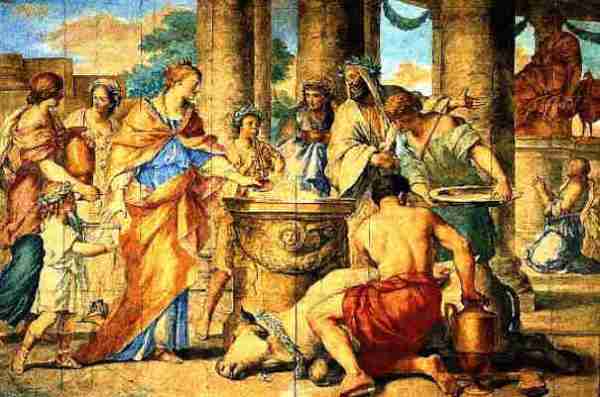
sacrifice-to-junoAs we enter the season of the Christian holiday, Easter, the concept of the blood sacrifice of the innocent weighs heavily on my mind—or should I say, the fact that people are okay with this concept, weighs heavily. So often Christians seem to brush past the gruesomeness of this tale without really thinking about it, but others dwell on the horrors yet seemingly only recognize the injustice of the punishment and feel guilty and grateful that Jesus was sacrificed instead of them. Needless to say, I have a lot of problems with either of these views.

Let me start by saying that I don’t believe the crucifixion and resurrection of Jesus even happened, but let’s say for a moment that it did. The idea that it is moral for an innocent life to stand in substitution for the punishment of an actual guilty party is abhorrent. Of course, the counter argument to this is that he is giving his own life freely, not sacrificing someone else. This still makes no sense. Who made the rule that there has to be blood to pay a price for sin in the first place? God makes the rule, knowing that he’d have to kill his own son to meet the requirements of his own rule. His own rule does not make sense in the first place. Why would the blood of an innocent atone for a guilty party?

Besides, he did not just sacrifice himself/son (however you want to look at it). All throughout the Old Testament, God requires the sacrifice of the innocent—lambs, pigeons, doves, goats, children, including Isaac. The story of Abraham and Isaac, wherein God tells Abraham to slaughter his son, and then at the last minute, says he was just testing him, aside from being cruel and sick, is said to prefigure the sacrifice of Jesus, God’s son. So, how is it righteous to slaughter an innocent animal on an altar for the forgiveness of transgressions by man? You guessed it! Because God said so. He made the rule, yet we are supposed to be eternally grateful that he had Jesus slaughtered brutally, so we could feel guilty (and loved which just creates more guilt in this situation) throughout all eternity. There is clearly no logic in the idea that the blood of the innocent makes up for anything done by someone else. Conversely, it creates another sin to compound the first.

But this saves us from going to hell—which God created, a place supposedly created for Satan and his followers, but for some reason, he is perfectly willing to allow us to go there as well, even for the sin of being unable to believe the unbelievable—unless, of course, he gets his blood sacrifice. Although this is clearly illogical, heinous, and in no way moral to the average person if we took God out of the story and replaced him with any other being, we do see this concept over and over throughout mythology and in many ancient pagan religions. Blood sacrifice was known to be part of religious ritual and even for the forgiveness of sins among early Hebrews, ancient Greeks, ancient Romans, ancient Egyptians, Aztecs, Pre-Columbian civilizations, and is suspected in countless cults, not to mention being the subject of numerous ancient myth stories. Obviously, this is a concept familiar and acceptable to primitive mankind, but should we still think it sounds like a good idea today? Should we calmly accept it as the foundation of the beliefs of a modern and educated culture? Do we really think it is justice for a rapist, a murderer to go to paradise because he believes that Jesus took his punishment? Would this make sense to you if you were not conditioned to believe it?

If God wanted to forgive mankind, he could have made any way he wanted to to accomplish that. He could have just forgiven those who were sincere—he’d know their hearts, right? He could have made them do something to make up for their crimes—maybe something along the lines of restitution? Something that fits the crime? If this story was not in the bible and drilled into our heads since birth in our country, would we not find this story abhorrent, immoral, and illogical? We are so used to hearing it that it sounds normal, and when everyone around you believes it, it’s easy not to even question it. I encourage you to question it, examine it, and do so with the attitude of someone who has never heard it before, and see if you can possibly still believe it. This is my challenge for you this Easter if you are willing to accept it.—Christina Knowles

Originally published in 2015

Photo via talesbeyondbelief.com

Review: Lost December by Richard Paul Evans

11110218

At first I thought this book would be another story like A Winter Dream by the same author (a re-telling of Joseph and the Coat of Many Colors) but based on The Prodigal Son instead; however, this prodigal son tale was pretty original for a re-telling. I thoroughly enjoyed it and actually had sympathy for Luke, the son who left home, squandered a million dollar trust fund, and ended up homeless on the streets. Luke didn’t actually spend all the money himself, which helped in the sympathy department; he trusted the wrong people who took advantage of him. Nevertheless, Evans does an excellent job of showing how gradually one’s values and priorities, and even personality can change in the right (or wrong) environment.

This feel-good “riches to rags” story operates well on another level as well. Not only does it remind us to remember what is really important in our lives and that the source of true happiness is not found in material possessions and in short-lived experiences, but it shows how impossible it is to break out of the cycle of poverty and homelessness without help, while still emphasizing the value of hard work and determination. Maybe a little too much on the side of ambition.

Evans builds up Luke’s father to angelic heights as a decent, caring, and ethical corporate executive, which I guess is understandable since he would be “God” allegorically speaking since the father in the original represents God. Kind of an allegory within an allegory in this case. Evans seems to idealize the honest businessman, but at the same time, he acknowledges the all-too-familiar greedy and immoral tycoon. Of course, Luke realizes the value of an honest day’s work and sacrifice, but once on the street, he isn’t given a chance until a charitable do-gooder gives him a hand up. Evans does a great job of showing the reader the hopelessness of the plight of many.

You probably know the story of The Prodigal Son, so it won’t be a spoiler to let you know that Luke finds his way home into the forgiving and open arms of his father. It’s not as corny as it sounds. This book was a wonderful holiday read without being too preachy or saccharin. It thoroughly delivered on Christmas spirit. 4 out 5 stars.

HOW DID SOMEONE LIKE ME COME FROM SOMEONE LIKE HER?

487621_10200758992491296_159329911_n

I love my mom SO much it hurts.  Her name is Nora, and she is in a nursing home by herself since my father, the love of her life, Harold, passed away last April. Before he died, they lived in there together. The staff of the nursing home thought they were so cute because they had been married 61 years and looked out for each other in every way. When he passed away, no one thought my mother would hang on much longer. Especially since the doctors told us she had only about three months to live over a year ago.

Last night I went to visit her. I try to go twice a week, but I confess, sometimes I only make it once a week.  I justify it because I’m busy with a full-time job as a teacher and a part-time job as a writer. I leave work late, work long into the evening, and work on weekends. She has visitors everyday because I have a big family who all visit regularly. But that’s no excuse. She deserves better. She never complains when she hasn’t seen me in a week. Instead she tells me how proud she is of me and how she loves me so much.

As I said, last night I went to see her. Suddenly she teared up and told me she was worried about the staff of the home, the nurses, the CNAs, the janitors. My mom has always been a very religious person, a Christian. My brothers and sisters and I were raised in the Baptist church, and my mom took it seriously. I, on the other hand, have always struggled with faith and had trouble believing the bible. I always hid this from my mom because I wouldn’t hurt her or worry her for the world. And she does worry–because she cares so much. She was crying over her worry that all the CNAs, nurses, and other staff might not be saved. She told me she asks everyone if they know Jesus and if they have given their lives to him. Sometimes they say yes, and other times they talk to her in depth about what they do believe. She prays for them, she cries for them. She tells them that Jesus died for them and that he loves them. This is typical of my mom because she always thinks of everyone else’s needs before her own. My mom told me that she believes that the only reason God has not taken her home to be with her beloved Harold is because she is supposed to tell the people in the home about Jesus. This is the first time my mom mentioned to me wanting to go to be with my dad. She is always cheerful and sweet, kind to the staff and to everyone. She doesn’t complain, so much so that the staff says they don’t even know when she is having a medical issue until she is really in pain because she doesn’t say anything.

She isn’t concerned for them out of any sense of superiority or condemnation. She cares. She loves them. She hurts for them. She tries to make their lives easier. She once told me that they have a terrible job, cleaning up accidents, bathing and dressing the residents, lifting them out of bed, helping them on and off the toilet. She said she wants to make their lives easier and happier by always saying thank you and being nice, polite, and not complaining. Personally, I think they are lucky to take care of her.

No matter what your personal beliefs are about Christianity and people who “witness,” sharing their views with others who may not want to hear them, you have to give her credit for her love. My mom loves them, regardless of their beliefs, with a true and sincere love. She is in this nursing home, crying for people, for some who are not always as nice and gentle as they could be, who are not always kind or helpful. This is her amazing gift, her soft heart, her unselfish love for others. She is an amazing example of love to me. She is true Christianity. She is being Jesus to the world. When I look at her, I am in awe of her. Then I ask myself how someone like me came from someone like her.–Christina Knowles

Blog at WordPress.com.

Up ↑