Religious Persecution—in America? by Christina Knowles

Snagged from Media Matters for America

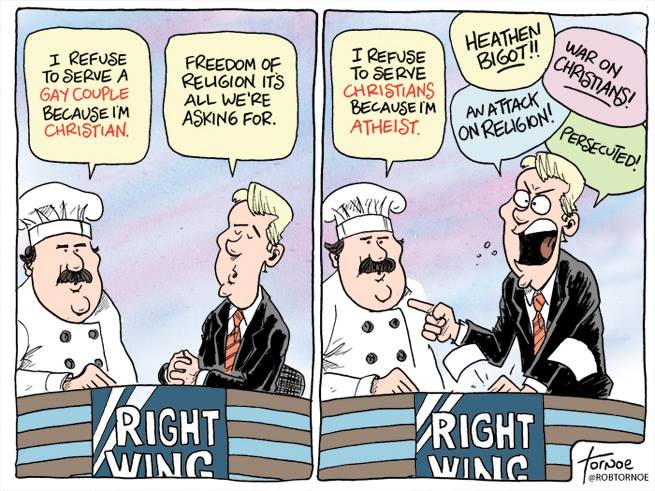
If you are listening to Christian radio or Fox News lately, you may think religious persecution is running rampant in America right now. But is it really?

If you think you are being persecuted for your religious beliefs, ask yourselves these questions: Is anyone trying to stop you from praying, reading your holy book, or worshipping in your own home? In your place of worship? Is anyone trying to stop you from imposing your religious views on others publicly? If you can honestly answer yes to the first two, then perhaps, you are experiencing persecution. However, the latter is not persecution. It is you trying to persecute others, and is therefore, not protected under religious freedoms. Or at least it shouldn’t be.

Here are some examples of actual religious persecution.

  • Jesus Christ’s crucifixion based on his religious claims and those of his followers.
  • John the Baptist’s beheading based on his belief in Christ as the messiah.
  • Constantine’s destruction of pagan and Roman temples and his intolerance of all non-Christian religious practices.
  • Mary Tudor’s slaughter of Protestants who refused to convert to Catholicism, which earned her the name of Bloody Mary.
  • Hitler’s attempt to exterminate the Jews and the slaughter of 6 million Jews under his leadership.
  • Joseph Stalin, who was against all religion and demanded atheism be embraced by all. He killed thousands of people because of their religions, destroyed temples, and outlawed Protestantism, Catholicism, Buddhism, Judaism, Islam, and more.
  • Charlemagne persecuted the Saxons, insisting they convert to Christianity.
  • Martin Luther was killed for his reformation of the Catholic church, but was also, himself, a controversial figure for the anti-Semitic sentiment in his writings.
  • On-going persecution of Christians in China, which includes, beatings, imprisonment, confiscation of religious materials, and executions.
  • In Africa, there is much Christian vs. Muslim persecution erupting in violence and death. For example, the recent Islamic terrorist attack at a Kenyan college, killing 147 Christians.
  • In the Middle East, Christians are persecuted by Muslims, Muslim groups persecute each other, and then there are the devastating effects of the Israeli-Palestinian conflict, which many believe is rooted in differences in religious ideology.
  • In America, today religious persecution may exist on a very small scale. Individuals are discriminated against in work environments or at school, but it is not widespread. Probably the most persecuted group in America today would be the Amish, who are frequently attacked when venturing out of their communities. But even these are isolated events.

Many people believe that Muslims are the most hated or persecuted religious group in America today because of the association of terrorism with Islam in the Middle East and because of the attack on September 11, 2001. But while the sentiment of many Americans may be anti-Muslim, actual persecution is also limited to isolated events.

Merely being discriminated against or even hated does not constitute religious persecution. Religious discrimination is against the law and people on the receiving end of discrimination in America have the opportunity for fair legal redress, which in itself, shows that this is probably not at the level of persecution.

Individual people will always discriminate and infringe on the rights of others, but when this is sanctioned by the state, no protections are in place, and no justice is available, then it can truly be called persecution. One might question if isolated incidents of hate crimes constitute actual persecution in the academic sense or just criminal activity by a prejudiced few, which will not go unpunished. If so, no one in America can claim to be persecuted on the basis of religion.

If your idea of religious persecution is that you are not able to infringe on the rights of others to practice your religion, then you are mistaken, and frankly, that’s just too bad.

In the news recently, there have been a variety of groups suing the government and petitioning for laws to protect religious freedom, when in fact, religious freedom already exists and is protected by the Constitution. If refusing to serve someone based on his religion appeals to you, then opening this can of worms is likely to backfire on you. Already, we’ve seen cases of signs appearing refusing to serve Christians on the grounds of “deeply-held religious beliefs.” All one has to do to see the inherent discrimination in these types of protections for businesses is to replace “Christians” or “homosexuals” with “blacks” or “Asians,” and we immediately become incensed with righteous indignation, saying, “They can’t do that! That’s illegal!” What’s the difference? Do you really believe that your religious freedom entitles you to discriminate against others in a public place by refusing to offer goods and services? No one is trying to prevent you from exercising your religious freedoms. But you cannot, in America, run a business open to the public, and then discriminate against people based on your religion or theirs. That sounds a lot like Nazi Germany. Saying you can’t do that with your business, does not mean, you are being persecuted.

Try being an atheist in a country where atheists are prevented from holding public office in seven states (West). Can you even imagine our country electing an openly atheist president, or imagine the ridicule a sitting president would incur if he refused to say a prayer at the Prayer Breakfast or at the National Day of Prayer? Yet, the very religious folk who are so vocal about religious freedom have no issue with religious tests for public office, using religion to campaign, or to freely criticize the lack of religion in candidates and politicians.

Unfortunately, the inability to “put the shoe on the other foot” is at the root of this ridiculous controversy over religious freedom. Instead of demanding your right to deny others rights, try to imagine what you would feel if that happened to you. I believe that most people do not want to hurt others or treat them unfairly, but when our sense of justice and our fear of losing our own rights cause us to treat others unfairly or unkindly, then we need to take a step back and ask ourselves what we are really trying to accomplish. Maybe by remembering what real persecution looks like, we can more realistically look at our own fears. Fear seems to be at the heart of this issue, and decisions made on the basis of fear are rarely rational or effective, and are often divisive. Really, can’t we all just get along?—Christina Knowles

Originally posted in 2015

Sources:

West, Ellis M. (2006). “Religious Tests of Office-Holding”. In Finkelman, Paul. Encyclopedia of American Civil Liberties. CRC Press. pp. 1314–5. ISBN 978-0-415-94342-0.

The War on Teachers by Christina Knowles

hands_bars_prison_jailBy now I’m sure everyone has heard that eleven Atlanta teachers have been convicted and sentenced on racketeering and other charges associated with conspiring to cheat on state standardized tests. This scandal shocked the nation and teachers for different reasons. While the nation shook their heads in disgust at the dishonest actions of those entrusted with the education of their children, teachers nodded in understanding—I don’t mean to say that they condone their behavior in any way, but we certainly understand it.

If you haven’t heard, eleven teachers apparently changed the answers on student standardized tests and passed them off as student work. The failing school where they worked reveled in the jump in student achievement, and when they were caught, all the major news outlets attributed their motivation to bonuses and incentives—but immediately, I was skeptical. There is no way any teacher would risk losing his career, punishment by the law, his ethics, and waste years of education for accolades and a bonus.

It didn’t take long for the truth to emerge. According to Valerie Strauss of The Washington Post, this was not likely the motivation. In her April 1, 2015 Answer Sheet blog, she attributed their actions to “pressure to meet certain score goals at the risk of sanction if they failed” (Strauss PG 1). This might sound ridiculous to anyone who is not a public school teacher, but every year incredible pressure to outscore the year before is placed on teachers who are threatened with losing their jobs or having their schools shut down based on these scores.

I know what you’re thinking—Why don’t they just focus on doing a better job teaching? For an American school teacher in today’s society, meeting the impossible and ever-growing demands of this thankless job is not even remotely possible. Meeting the minimum requirements of a public school teacher demands a 14-16 hour day, and in reality, teachers could work round the clock and never catch up with what “needs” to be done.

Most of a teacher’s day involves actually teaching in the classroom, then meeting one-on-one with students, contacting parents, attending meetings, and copying the material they stayed up until midnight the night before researching and writing. Every night and weekend consists of grading hundreds of papers, lesson-planning, reading and researching for future lessons, and contacting any parents that they ran out of time to contact during the day. Maybe, if there is any time left over (yeah, right), they will analyze data and make plans on how to reach individual students who are struggling. An American high school teacher today has between 150 to more than 200 students to reach individually.

Today’s students are not the students of yesteryear, further complicating the job of the teacher. Today’s students have had it drilled into them that everything is the teacher’s responsibility. If they are not learning, then the teacher needs to adjust the way he teaches. If it is hard, then the teacher needs to make it easier. If he is failing, then Mom and Dad need to set up a meeting with the administration and give the teacher more responsibilities, such as typing up notes, modifying tests, and creating lots of alternate assignments to make sure the child succeeds, even though these accommodations don’t result in anything except a meaningless diploma—and lower test scores. Today’s students are allowed to be disrespectful in class and disrupt the learning of those who are trying with very little, if any, consequences for their actions. The teacher has no power to enforce detentions or any other punishment, and with the implementation of Standards Based Grading, students receive no negative consequences for ignoring homework. Sure, they will fail the test for lack of practicing their skills, but they can just take an easier, modified version of it after they Google the answers. If a teacher won’t allow this, Mom will set up a meeting. Maybe she will even get that teacher fired. And this does not even take into account attempting to mitigate the damaging effects of poverty, violence, and apathy with which some students deal on a daily basis.

Meanwhile, with every new requirement, with every new impossible expectation, worn out, stressed teachers continue to try and meet every demand for two reasons: They actually care about the kids, and they spent years preparing and doing this job and don’t want to throw it all away and start a new career. If only I can make it to retirement and collect my meager public employee pension, they think, I can just substitute teach, because even though they love the kids and the content, they only have so much to give.

Combine this with a struggling economy, student loan debt, and medical care for their acquired stress-related illnesses, and demoralized, unappreciated, and harangued teachers just may be beaten down enough to compromise their ethics and cheat when threatened by demanding administrators and superintendents to deliver the scores or be fired.

According to Strauss, this was likely the case when Atlanta public school superintendent, Beverly Hall, who died shortly before the trial of the eleven teachers under her supervision, refused “to accept anything other than satisfying targets [that] created an environment where achieving the desired end result was more important than the students’ education” (PG 2). Hall and her top administrators did not threaten job loss just once before the crime was committed. This atmosphere of fear and oppression continually built over a period of several years to the point that when the cheating began, it was encouraged through fear and reward. Teachers who blew the whistle were quickly fired, while teachers who cooperated were awarded with praise and bonuses, in effect, creating a hostile environment of coercive practices by those in charge (PG 2).

One of these eleven teachers avoided jail time by making a plea deal and giving up the right to appeal, another managed to receive weekends in jail, and the rest received up to seven years in prison (Calamur PG 1). It is unbelievable to me that they would receive any jail time! College students who cheat on tests don’t even fail a class anymore, but we are going to throw the book at a few emotionally broken-down teachers trying to keep their jobs?

Of course, Hall is not here to take the responsibility, although surely she bears more of the guilt than any of the teachers, but in my estimation, the true responsibility for this disaster of public education lies with the government. Every year there are new rules and responsibilities to contend with, new threats of losing funding, new batteries of endless tests, all which serve only to further corrupt and destroy the system of education for our children. Why are they not on trial? Why are they not held responsible for declining scores because they are the true cause. They started this wrecking ball rolling in the path of every public school in America, and teachers and students had better get out of the way because it doesn’t appear to have any intention of stopping. Why should it, when teachers make such a convenient scapegoat?

So, yes, I understand why they did it. I get it. And I don’t think they deserve to spend one day in jail. In fact, I think they should sue their district and the government for creating such a hostile work environment and coercing them to cheat (I won’t even call it a crime because that is so ridiculous). These are not criminals. These are the used and abused teachers who loved our kids, who year after year, gave everything they had and more to help them succeed, and we said it wasn’t enough.

Although I work in an honest district where the strictest protocols for testing are followed, and no one even hints at altering tests, we still feel the ever-growing pressure from the state, and so do our students. The more tests we have to give, the more, understandably, the students rebel. During our last testing session, half of my students drew pictures instead of answering the questions or just held one letter of the keyboard down and filled the page with gibberish. They don’t care anymore. They want to be more than a test score. They want to do more than take tests. They want to get excited about something that inspires them to learn.

Luckily, I teach in a district with a principal who is supportive and understanding, yet even as this is the case, we, as teachers, feel the pressure. So, would I ever be tempted to change answers? Cheat on a standardized test? Fortunately, I am not even tempted. Not because it is such a detestable crime, not because there is no one telling me to, but because I just don’t care anymore. That’s what this system has done to me. Much like the students, I don’t care if they pass or fail a stupid state test. I do, however, care about them. I care that they learn to think and to communicate. I care that they find a passion and pursue it, something that will inspire them to passionately investigate.

So, that’s what I teach them, and if my kids fail the tests, then they can call me a bad teacher and fire me. So what? I am a teacher. A public school teacher is highly employable because they are skilled and intelligent and capable of working long hours in the worst conditions. We put up with abuse, disrespect, and blame while never letting it change our love for the students or how we interact with them. Anyone would be smart to hire a former teacher because we are highly educated, critical thinkers, creative, good communicators, great at thinking on our feet, and excellent multi-taskers. Go ahead and fire me for low test scores and bad evaluations based on impossible tasks. You’d be doing me a favor. The only thing that worries me is who will replace us? Who will they get to teach our precious children when they have driven the last of the good teachers out of the profession?

We can say these eleven teachers were bad, and we are lucky to be rid of them, but our system made them in to what they became, and then turned them into yet another knife to stab at the profession. But I won’t make them the scapegoat. It’s time to stop blaming teachers, or we won’t have any teachers to blame. –Christina Knowles

Originally posted in 2015

Sources

Calamur, Krishnadev. “Jail Terms Handed To Most Atlanta Teachers Convicted In Cheating Scandal.” The two-way: BREAKING NEWS FROM NPR. NPR.org. 14 Apr. 2015. Web. 23 Apr. 2015

imgbuddy.com. Photo of jail hands. web. 24 Apr. 2015.

Strauss, Valerie. “How and why convicted Atlanta teachers cheated on standardized tests.” Answer Sheet. The Washington Post. Washingtonpost.com. 1 Apr. 2015. Web. 24 Apr. 2015.

Rainbow Justice and Republican Jeers by Christina Knowles

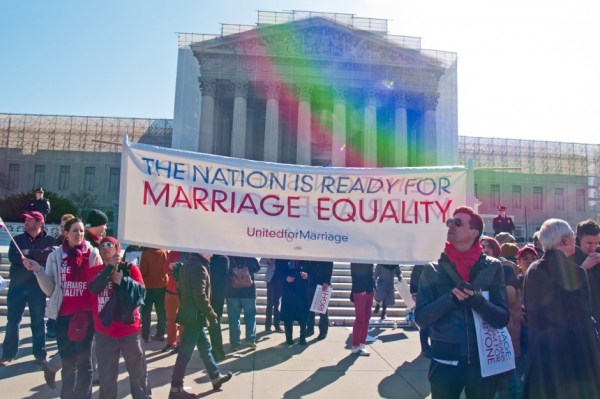
Gay MarriageAs expected, today’s landmark ruling by the Supreme Court was met with more appeal-to-fear and slippery slope fallacies from the Republican presidential candidates. Yet, every ridiculous doom-and-gloom scenario of which they speak does not fail to inspire the query, “Can they seriously think that?” Unfortunately, I fear they might. Either that, or they think that’s what their constituents want to hear.

But according to a 2015 Pew Poll, 57% of Americans now support gay marriage. Some speculate that these candidates are pandering to the Evangelical Right before the nomination, and the nominee will then reverse tactics to appeal to the general population after the primary. Either way, their ludicrous and fallacious arguments will be recorded for future generations’ amusement for years to come.

According to NBC News, Huckabee equated our Supreme Court with the British monarchy of the 18th century, calling our highest court’s ruling “judicial tyranny,” and went on to say the ruling would be “one of the court’s most disastrous opinions” (qtd. Dann and Rafferty). No, that would probably be Citizen’s United, and the three branches of government, including the Judicial Branch, were conceived by our forefathers whom Huckabee so admires. I don’t think they would have considered our courts tyrannical, language which in this context seems to attempt to stir up a rebellion against our own government.

NBC’s Dann and Rafferty also reported that Governor Bobby Jindal of Louisiana, a Republican presidential candidate, stated that the ruling “will pave the way for an all out assault against the religious freedom rights of Christians who disagree with this decision” and that “Marriage between a man and a woman was established by God, and no earthly court can alter that” (qtd. Dann and Rafferty). So, is he suggesting that the ruling be based, not on the Constitution, but on the bible? Apparently, he does not worship the hallowed ground of our forefathers as Huckabee does, but would rather throw out our entire system of government in favor of Levitical law. I’m still not quite sure how couples of the same sex committing to love and honor each other for the rest of their lives could have any effect on Christians who disagree with them, other than giving them an object for their disdain or a target for their prayers. Certainly “an all out assault against their religious freedoms” seems a far-fetched slippery slope with no basis in even a moderately conspiratorial mind. No wonder I’ve never heard of Jindal before. He won’t make it far in this race with that kind of crazy talk.

The same reporters quote Santorum, in a much more reasonable voice, as encouraging the American people to continue the debate as if the Supreme Court did not have the last word (I never thought I would use the word reasonable to refer to Santorum) and Walker as saying “the only alternative left for the American people is to support an amendment to the U.S. Constitution to reaffirm the ability of the states to continue to define marriage” (qtd. Dann and Rafferty). They also reported that Perry and Rubio believe that the ruling was against the constitutional rule of law, and that Christie thought it should be in the hands of the “people” (qtd. Dann and Rafferty).

The argument that the states should decide cases of discrimination is absurd. Civil liberties are always, or at least they should be, constitutional matters. If we left cases of discrimination up to the states, or to a public vote, the Civil Rights Movement would have died on the state level. The Constitution of the United States guarantees civil liberties and equality to all Americans; therefore, it has nothing to do with states’ rights and the rights of one marginalized group should never be left to the whims of the mob. It would be unconstitutional to pass an amendment to discriminate against a group of people. It would also be unconstitutional to implement discriminatory laws based on favoring one religion’s laws over another’s, as would be the case in Jindal’s view. Actually, Jindal believes the bible should trump the constitution. Unfortunately for Jindal, he lives in a country where the constitution is the law of the land, not the bible, and in the United States, imposing your religious views on others is frowned upon.

Why don’t they come out and really say what they mean? Gay marriage is not going to infringe on anyone’s religious freedoms. What they are really upset about is that they don’t get to dictate what kind of morality will be practiced by their neighbors. They don’t get to live in a perfectly conservative world where everyone believes in their ideologies and lives by their rules. The world is not going to spiral out of control just because same-sex couples are allowed to marry. And unfortunately, the conservative bigotry will be allowed to continue unfettered because we don’t get to dictate what they believe any more than they can dictate to others who they can marry. But I suspect, what they really mean, they could never say, that they will pretend to be God-fearing, bible-believing, good ol’ boy defenders of morality until the day after the primary election, at which time, they will demure to the “law of the land,” and focus on that other favorite subject of the Republican party—protecting the cash flow of the wealthy.

In the meantime, Americans will celebrate our victories, knowing the tide of public opinion, as the Pew Poll indicates, is rising on the side of human rights and kindness.–Christina Knowles

Originally posted in 2015

Sources:

“Changing Attitudes of Gay Marriage.” Pew Research Center. pewforum.org. 8 June 2015. Web. 26 June 2015.

Dann, Carrie and Andrew Rafferty. “2016 Candidates React to Supreme Court’s Gay Marriage Ruling.” NBC News/Politics. nbcnews.com. 26 June 2015. Web. 26 June 2015.

Photo snagged from indianpublicmedia.org

Angry Atheist or Justifiably Angry? by Christina Knowles

Religion  We’ve all heard of the stereotype of the “angry atheist,” and I’m really tired of it and all it implies. If you really want to know why this atheist is sometimes angry, I’ll tell you, but you aren’t going to like it. I’m tired of being told that I am angry at a god I don’t believe in. I’m not, but lately I have been angry at some of those who believe in this god.

In general, I am a happy and pretty serene person. I am easy to get along with, I don’t get mad very easily, and I can’t think of any wrong done to me that I don’t easily forgive very quickly. However, I am angry at religion, at least organized religion. I don’t really have a problem with vague beliefs of some abstract spirit world where are there are no holy documents dictating how everyone else is supposed to live, regardless of whether or not they also believe it.

The kind of religion that makes me angry is the kind that is preventing progress, inhibiting intellectual reasoning, brainwashing children and cultures, interfering with the rights of others, and destroying our world. That’s right, destroying it. And I’m not just talking about the terrorism of some Islamic groups, or the overt oppression of homosexuals and women, but, at least in the United States, I blame fundamentalist Christianity for the dumbing down of the world when it comes to science, the environment and climate change, over-population, and for popularizing the belief in the superiority of mankind and his “dominion” over animal life and nature, as well as attempting to morally justify the worship of capitalism and making it acceptable to vilify and oppress the poor. Religion is leading to a mass extinction on our planet.

Any species that takes more than it needs from its environment eventually becomes extinct. The only way out of this that I can conceive is education. Education in science, history, literature, social studies, math, in everything, including de-bunking religious superstition. As long as people are conditioned to check their brains at the door and believe a book written by bigoted men thousands of years ago, men who had no understanding of science and every reason to perpetuate thought which put them in control. This book causes good people to discriminate against other good people, this book causes women to accept or even welcome their own subjugation, and this book causes intelligent people to dismiss intellectual thought in lieu of “faith,” which leads to denying scientific fact and embracing fantasy notions of escaping this planet for an imaginary perfect place where none of the people they find offensive will be allowed to go.

And when you believe there will be a new earth, why take care of the old one? Why not have “19 kids and counting” if a god will take care of all of them or rapture them up and take them to heaven? We don’t need to worry about the exponentially growing population and the fact that we do not have enough resources to support them or enough jobs available for them as they become adults. And if animals do not have souls, and men do, obviously, men can do whatever they want to them. And prejudice and discrimination against those who do not agree that your god makes the rules is suddenly justified because you are just “trying to save them” and are worried about their eternal souls.

One of the most disturbing things about American Christianity is the apparent worship of capitalism and the disdain for the poor. While, in the past, Christians prided themselves on caring for the poor, this new generation of Christianity seems to prefer quoting aphorisms about God helping “those who help themselves,” “no working-no eating,” and “teach a man to fish,” etc., effectively blaming the poor as being lazy without looking at factors such as opportunity and oppression, instead, promoting corporate greed as God’s blessings for the entrepreneurial spirit. They seem to think that if they please God enough, enforcing his edicts on the world, they, too, will be blessed with riches.

But if you really want to know why I am angry, you first have to understand my perception of religion. While Christians may think I am lost, I think, as a former Christian, that I have awakened and narrowly escaped a cult. I believe that Christians are nice people, more often than not, who have been deceived and brainwashed into joining a damaging and intellectually debilitating cult. This cult lures people in by quoting the nice parts of the bible, and there are a few, very few. These people are drawn in by the idea of an all-powerful and benevolent being who personally created them and loves them. They aren’t immediately informed about this god’s past immoral and psychotic displays of rage on humanity. And when they do run into these passages, eventually, they are explained away with such illogical nonsense as “We can’t begin to understand God,” or “Because God is perfectly just, He has to destroy sin,” (even the innocent children, apparently, and despite the notion that He created it), or my personal anti-favorite, “You just have to have faith.” Why? Why would anyone think it a good thing to believe something for absolutely no good reason, contrary to the observable evidence, and with no supporting evidence of its own? Especially, blissfully ignoring the fact that this god seems strikingly similar to a very flawed, over-emotional, prideful, vindictive, and sexist early Middle Eastern man. This is exactly what I mean. This cult ensures its survival by making sure its members believe that looking too closely at its logic is a bad thing and blind faith is admirable.

I’m sure at this point, some people are thinking that I sound like I am mad at God. I’m not. I don’t believe he exists, but if the god of the bible were real, I certainly would not find him worthy to be worshipped or obeyed, not to mention that he seems to be a trickster engaged in the longest hide and seek game of all time. However, I am mad that this mythology is continuing to block progress and affects millions of people who do not share these beliefs. I am angry that persistent sexism exists because of religion. I am angry that discrimination of all kinds of people exists because of religion, that wars are started over religion, that disdain for the poor exists because of religion, that scientists are scoffed at because of religion, that we are killing ourselves, plant life, and animal life because of religion. I don’t mean to single out only Christianity for the blame; there are other factors, but, in my opinion, it is this dominant religion causing the most harm here in the United States. I am angry that in America, there are still some laws on the books that prevent an atheist from holding political office, which is completely unconstitutional. Personally, I would rather see a person who depends on reason in charge of public policy than someone who wants to determine what is right and wrong from an ancient book that should have long ago been relegated to the status of mythology, a category to which it most certainly belongs. However, we all know that even if there were no “religious test” for public office, the “moral majority” of America would never elect even the most ethical and upstanding atheist as president. An atheist would be forced to pretend to have the popular religion in order to have a chance for a political career in the United States.

Yet, Christians cry religious persecution all the time—whenever they are prevented from forcing their religious dogma on others. It is not enough anymore to spread the gospel, they must enforce their imaginary god’s laws on rational people who think they are delusional. I apologize if this is too blunt, and I want to make sure everyone understands that I do not think Christians are stupid. They aren’t. They are brainwashed, usually from birth, indoctrinated into a culture of Christianity and held there by fear of hell, fear of losing community and family, and being ostracized as godless heathens. When Christians do allow themselves to doubt and question, they are quickly reined in and corrected. And even when they no longer believe, they fear admitting it. I was once among them, and I feel for them, but I refuse to stand by silently while they destroy the world I, too, must live in. So, yeah, I am angry, and I do feel the need to say what I think is really going on, but I am not mad at an invisible dictator in the sky whom I do not believe exists.

I am not an angry person. I am a person who gets angry, especially when it really matters. I am a moral person, and I want to see us solve problems and move forward in a way that best protects our future. So you see, in this way, we aren’t really that different. We both think the other is ruining the world, we both think the other is deluded. However, I don’t think you are going to hell. I think you can be woken up. I think you can snap out of it and realize the wool has been pulled over your eyes. I’m sure you think I could come back to Christianity, but I won’t because I never want to believe something for no reason again. I want to see a new age of reason emerge, and the United States return to its former position as one of the world’s freethinking leaders of democracy and scientific thought, rather than being known as the largest free country still holding on to magical thinking and holding back progress. Reason, in the end, is the only savior out there, and I’m justifiably angry because we are encouraging ignorance and fantasies over rationality at the cost of our future.—Christina Knowles

Originally published in 2015

Living for Breaks by Christina Knowles

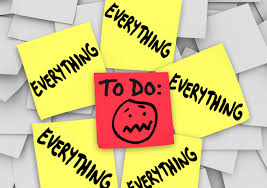
To-do listToo often being a teacher means living for breaks. Fall break, spring break, winter break, and summer break—that’s when we will begin living again.

In the life of the teacher, particularly high school English teachers, but also for most kinds of teachers, breaks mean catching up on everything from cleaning the house to exercising. There simply is no time during school to do anything other than school work.

I’ve tried to change. Every year I make new promises to myself about how I’m going to erect boundaries and take time for friends, family, and personal interests, and every year, I get trapped in the I’ll-get-to-that-on-break lie. Here’s the problem. By the time break comes, I have accumulated so many things on my list of catch-up-on-break items that I can’t possibly get through half of them, and thus, I am sometimes even more stressed out over breaks.

For example, I have not properly cleaned my house in over a month, I have piles of mending to complete, piles of stuff to organize, the paint is chipping—all the paint—on everything, and things are breaking and wearing out all around me. I quit exercising about three weeks ago to catch up on grading and to get more sleep that I lost out on while grading papers and attending nighttime parent-teacher conferences. I quit meditating several weeks ago on Sunday mornings to plan for the coming weeks of school and to write tests I had to administer before the end of the quarter. I quit cleaning the house to grade papers before parent-teacher conferences. I put away the book I was writing when school started and haven’t touched it since. My poetry collection is waiting for me to finish the cover, but I said I’d do it over break. My fish are gasping for breath in want of fresh water, and my dog forgot what it was like for his mother to walk him. I have so many pictures on iPhoto that I’m not allowed to take another photo on my phone, but I haven’t had time to save them somewhere else. I need appointments for my teeth, my car, and my body. My hair needs cutting, I haven’t had a manicure in six months, and my summer to-do list isn’t even halfway completed, and now it’s fall break.

When you are a teacher and everyone knows you have break, they naturally assume that now you will not be neglecting them—at least for two weeks. Your friends, your family, your kids, your husband, and your dog all expect that now you will finally spend time with them. And I want to—very much. However, after I schedule them into my calendar, the rest of the list looks pretty hopeless.

Of course, there were even a few school things that I thought I could nonchalantly slip into my fall break schedule—re-reading the chapter I’m teaching after break, writing a new unit, finding an example paper for that assignment the students are finding difficult. Why did I think I’d have time to do that over break? Because there isn’t time during my workday, or even in the evening when I finish grading.

Some may wonder how I find time to write this blog? I find time because if I don’t write, I will surely lose my mind, and then I will never finish my list.

On a positive note, I’m really glad I realized the futility of catching up on things so early in my break. Maybe now, I will be able to cast aside my hopes and expectations and actually relax. I’m not sure I can, but admitting the truth is the first step toward tearing up the list. We’ll see. Maybe I can just put everything on my winter break list because who needs to spend time with family celebrating Christmas? Maybe I’ll start living for retirement.—Christina Knowles

Originally posted in 2013

Photo source: pieceofmindcounselling.com

Morals Change–And It’s a Good Thing by Christina Knowles

scalesI hear a lot of people complain that morals are changing. Shouldn’t they evolve as we learn more? This leads to the inevitable debate of objective morality vs. relative morality. Morality seems somewhat subjective, but not completely relative, at least among thoughtful and intelligent beings. For example, we tend to believe that things are right or wrong on a standard of well-being. If the well-being of living creatures, for instance, is the standard, then we can develop an objective morality based on this even though circumstances will always dictate shades of gray in individual situations. So it must change as we change, right?

Over time, morality does indeed change. For instance, we now have more liberal views on things like punishing children, working on Sunday, considering a menstruating woman unclean, and understanding that homosexuality is not a choice. Certainly, we can acknowledge that most people now view slavery as immoral, genocide as evil, and democratic societies obviously have a different morality than totalitarian ones. At one time, great majorities of people considered these things right for one reason or another, so we know that morality changes.

Religious people tend to think we get our morality from a divine being, but this does not make sense if morality changes unless they are acknowledging that their god changes his mind as well. However, many do not admit this is the case. I would submit to them that they are more moral than the god they say gave them the basis for their morality. Even most bible-literalists in the Christian faith are far more moral than their god by today’s standards.

For example, the god of the bible told Abraham to sacrifice Isaac on an altar to prove his obedience. Abraham was willing to go through with this until God stopped him at the last moment, satisfied in his allegiance. When asked if they would be willing to sacrifice their own child on an altar if they thought their god had commanded them to, most Christians find the idea repugnant, which is a good thing. They often try to circumvent the point by saying that God would never ask them to do such a thing. I’m not sure why they think he would ask this of Abraham, but not them. Perhaps because their god, apparently, no longer shows himself to anyone. At any rate, they would not do it, which reveals that modern morality is more in line with well-being than the god who supposedly distributed this morality.

Another objection to this example is the contention that God would never make Abraham go through with it because God is good. However, Abraham seemed to have a close relationship with God, having direct access to God on more than one occasion. It seems he knew God and his character well, yet Abraham seemed to believe it was within God’s character to demand this sacrifice. He believed God would make him kill his son—and again, he supposedly personally knew God. And if modern Christians are right in thinking God would never ask them to do something like this, then at the very least, this is another indication of God’s changing character, or in my opinion, that he was just a creation of a harsh and cruel society of ancient men whose ideas of morality and what a divine being would be like are much inferior to that of modern man.morality-quotes-3

This is just one example of the numerous detestable and immoral things the god of Abraham demanded of his people. He also demanded genocide, rape, slavery, and the oppression of people based on race and gender. To say we get an objective morality from a source like this is ridiculous. We are much more moral than that. Their god seems to have the morality of an ancient Middle Eastern, patriarchal, and scientifically uninformed people group. I wonder why. –Christina Knowles

Originally published in 2015

Easter and the Concept of Blood Sacrifice by Christina Knowles

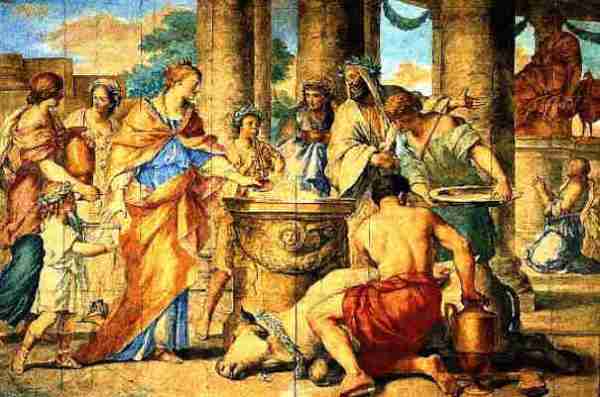
sacrifice-to-junoAs we enter the season of the Christian holiday, Easter, the concept of the blood sacrifice of the innocent weighs heavily on my mind—or should I say, the fact that people are okay with this concept, weighs heavily. So often Christians seem to brush past the gruesomeness of this tale without really thinking about it, but others dwell on the horrors yet seemingly only recognize the injustice of the punishment and feel guilty and grateful that Jesus was sacrificed instead of them. Needless to say, I have a lot of problems with either of these views.

Let me start by saying that I don’t believe the crucifixion and resurrection of Jesus even happened, but let’s say for a moment that it did. The idea that it is moral for an innocent life to stand in substitution for the punishment of an actual guilty party is abhorrent. Of course, the counter argument to this is that he is giving his own life freely, not sacrificing someone else. This still makes no sense. Who made the rule that there has to be blood to pay a price for sin in the first place? God makes the rule, knowing that he’d have to kill his own son to meet the requirements of his own rule. His own rule does not make sense in the first place. Why would the blood of an innocent atone for a guilty party?

Besides, he did not just sacrifice himself/son (however you want to look at it). All throughout the Old Testament, God requires the sacrifice of the innocent—lambs, pigeons, doves, goats, children, including Isaac. The story of Abraham and Isaac, wherein God tells Abraham to slaughter his son, and then at the last minute, says he was just testing him, aside from being cruel and sick, is said to prefigure the sacrifice of Jesus, God’s son. So, how is it righteous to slaughter an innocent animal on an altar for the forgiveness of transgressions by man? You guessed it! Because God said so. He made the rule, yet we are supposed to be eternally grateful that he had Jesus slaughtered brutally, so we could feel guilty (and loved which just creates more guilt in this situation) throughout all eternity. There is clearly no logic in the idea that the blood of the innocent makes up for anything done by someone else. Conversely, it creates another sin to compound the first.

But this saves us from going to hell—which God created, a place supposedly created for Satan and his followers, but for some reason, he is perfectly willing to allow us to go there as well, even for the sin of being unable to believe the unbelievable—unless, of course, he gets his blood sacrifice. Although this is clearly illogical, heinous, and in no way moral to the average person if we took God out of the story and replaced him with any other being, we do see this concept over and over throughout mythology and in many ancient pagan religions. Blood sacrifice was known to be part of religious ritual and even for the forgiveness of sins among early Hebrews, ancient Greeks, ancient Romans, ancient Egyptians, Aztecs, Pre-Columbian civilizations, and is suspected in countless cults, not to mention being the subject of numerous ancient myth stories. Obviously, this is a concept familiar and acceptable to primitive mankind, but should we still think it sounds like a good idea today? Should we calmly accept it as the foundation of the beliefs of a modern and educated culture? Do we really think it is justice for a rapist, a murderer to go to paradise because he believes that Jesus took his punishment? Would this make sense to you if you were not conditioned to believe it?

If God wanted to forgive mankind, he could have made any way he wanted to to accomplish that. He could have just forgiven those who were sincere—he’d know their hearts, right? He could have made them do something to make up for their crimes—maybe something along the lines of restitution? Something that fits the crime? If this story was not in the bible and drilled into our heads since birth in our country, would we not find this story abhorrent, immoral, and illogical? We are so used to hearing it that it sounds normal, and when everyone around you believes it, it’s easy not to even question it. I encourage you to question it, examine it, and do so with the attitude of someone who has never heard it before, and see if you can possibly still believe it. This is my challenge for you this Easter if you are willing to accept it.—Christina Knowles

Originally published in 2015

Photo via talesbeyondbelief.com

Stephen King’s Under the Dome, An Anti-Religious Right Political Allegory for Our Time by Christina Knowles

rennie-trump            I finally finished the 1,072-page Stephen King novel, Under the Dome, published in 2009. I started it over a year ago and lost interest about 400-pages in. I started watching the television show, which seemed nothing like the book and did not inspire me to continue reading. However, I am one of those people who cannot stand to abandon a book unfinished, so I recently picked it up again and started over from the first page. I am so glad I did, and I am glad that it was in the midst of this ridiculous election season that I completed it. I had no idea that it was a political commentary of the 2008 election season, and King’s criticisms are even more apt in this election year. Fair warning, this review contains spoilers, so read at your own risk.
under-the-dome            The super-short synopsis, just enough to paint a backdrop for this review, is that an inexplicable and impenetrable (except for a reduced air flow) dome descends suddenly over the small town of Chester’s Mill, blocking them off from the outside world. In a matter of a week, all hell has broken loose as one egomaniacal character decides, against democracy, to lead the people his way, which happens to be evil and corrupt. While some fall in line out of a false sense of security, others passively stand by, and a few actively resist.


Immediately, it struck me that King was likely influenced by two very classic tales and one dirty election season to write this novel. The first classic tale is William Golding’s Lord of the Flies, wherein, a group of boys are marooned on an isolated tropical island with no adult supervision. Quickly, the island descends into chaos when the democratically elected leader of the boys, Ralph, is challenged by a thug who decides he wants to be the leader, Jack. Ralph represents Barbie in King’s novel. Barbie is given leadership by the military leaders, who are monitoring things from outside the dome. Barbie cares about the people and is reluctant to take the leadership role but takes on the responsibility for the good of the people. Jack is Big Jim Rennie in King’s novel, an over-bearing egomaniac, who lets baser instincts rule and enjoys bullying weaker people around him, much like Jack bullies and finally kills Piggy with the help of his newly developed cult followers in Lord of the Flies.

And this is where it begins to mirror the 2008, as well as the 2016, elections. In King’s novel, Barbie represents civil and intellectual leadership (President Obama), and Big Jim Rennie represents the Evangelical Republican Right. Throughout the novel, Big Jim Rennie talks disrespectfully about that president with the middle- eastern middle name and how he does not recognize his authority over Chester’s Mill. Sound familiar? Additionally, Rennie is a fundamentalist leader in the radical right-wing church in Chester’s Mill. Rennie is corrupt, running a meth lab for profit, and justifies it by the good he does for the community and the church. Rennie thinks he and his cohorts are the only ones with a direct line to God and going to heaven, despite their heinous acts, including rape and murder. To Rennie, the ends justify the means, and he is able to excuse all his racism (His views on immigrants sound just like Trump’s.), sexism (He treats women exactly like Trump does.), and his disdain for the poor (This sounds just like Romney and Trump.). Oh, and Rennie makes fun of the handicapped and hates homosexuals too. Of course.

In Chester’s Mill, there are three main groups of people. The religious fanatics that resemble the Westborough Baptist Church. These people include Rennie and his misled and amoral followers. The next group are the members of the First Congregational Church of Chester’s Mill (The Congos, they are called in the community.). This group is the “normal” religious folk, the ones who go to church and kind of believe but are not dogmatic in their beliefs. They believe live and let live. The pastor is a woman who doubts the existence of God, but she continues to pray anyway. She is of one the good people, who eventually sides with Barbie against Rennie’s group. Also, in this group are the citizens who go to church outside Chester’s Mill but are not fanatics. These include the Catholics. This is an obvious commentary on the Religious Rights’ influence on politics and their insistence on legislating based on their own beliefs, while the “normal” Christians are not so dogmatic, question their beliefs, and do not think they should force others to live by those beliefs. The non-fanatical Christians in Under the Dome, eventually side with Barbie.

The last group is the non-believers, of which Barbie, the protagonist, is one. The people who claim no religious beliefs and think the rules should be based on democracy and reason are the leaders on the moral side in Under the Dome. As a secular humanist, I really appreciated this divergence from mainstream stereotypes and its connection to recent politics. Barbie represents fairness and reason in the novel.

Julia Shumway, another protagonist and journalist, is the token “good Republican.” Barbie continually says to her, “You don’t seem like a Republican.” And she does not. She is reasonable, fair, and represents journalism. She backs Barbie and fights Rennie from the beginning. I believe she represents fiscal conservatives, who have reasonable views on social progress. Perhaps, she even represents Independents.

Rennie is willing to do anything to be in charge, and engineers smear campaigns to discredit Barbie and his followers over and over, and eventually resorts to violence. Finally, climate change and the environment become an important part of the novel after a fire breaks out, and the dome prevents the smoke from getting out and clean air from getting in. Throughout the novel, Rennie wants to keep the dome up because he likes his reign of terror and control over the people and does not want it to end, even though it’s killing them. He continues to deny that their environment is not sustainable.

Barbie constantly works toward solutions to conserve energy, maintain order and civility, and solve the environmental problem of the dome. These are obvious allusions to climate change deniers on the right vs. environmental scientists. Rennie even talks about God delivering them and not allowing them to die from bad air. Barbie relies on science to work on the problem with Julia and another protagonist in the novel, Joe, a young sciencey teen. Do you think I’m imagining these political statements? No, they are very clear in many passages in the novel, but check out this one:

When Rennie is held up selfishly in a fallout shelter while people are dying all around him, one of his cohorts says, “’What if the air doesn’t clear. The TV said—?” and Rennie responds with a tirade of right-wing vitriol:

“’Oh, dear, the sky is falling, oh dear, the sky is falling!’ Big Jim Rennie declaimed in a strange (and strangely disturbing) falsetto. ‘They’ve been saying it for years, haven’t they? The scientists and the bleeding-heart liberals. World War III! Nuclear reactors melting down to the center of the earth! Y2K computer freezes! The end of the ozone layer! Melting ice caps! Killer hurricanes! Global warming! Chicken-dirt weak-sister atheists who won’t trust in the will of a loving, caring God! Who refuse to believe there is such a thing as a loving, caring God!’”

“Big Jim pointed a greasy but adamant finger at the younger man.

‘Contrary to the beliefs of the secular humanists, the sky is not falling. They can’t help the yellow streak that runs up their backs, son—“the guilty man flees where none pursueth,” you know, book of Leviticus—but that doesn’t change God’s truth: “Those who believe on him shall not tire but shall mount up with wings of eagles”—book of Isaiah. That’s basically smog out there. It will just take a while to clear out.'” But, of course, it doesn’t. Most of the town dies because of the air quality.

And under all this, there is another story going on, which relates to the second classic to which I referred earlier—The Twilight Zone episode “The Monsters Are Due on Maple Street” by Rod Serling. In “Monsters” an alien race experiment on a town by isolating them, cutting off the power, playing with them by turning on and off law mowers, etc. The fear cuts through the town until they turn on each other, the town descends in to chaos, and in fear, one of them shoots one of their own people. The chaos in Chester’s Mill is much like this. People begin fearing each other and lashing out without due process. This is made most obvious when Barbie and a fellow kind and reasonable person, Rusty, are imprisoned on trumped up charges, framed for the rapes and murders that Rennie and his son, Junior, commited, are beaten, and are to be executed without due process. The townspeople go along with it because they hear Rennie’s propaganda and believe the lies even though they are concerned and doubtful.

Like The Twilight Zone episode, it turns out that the dome is caused by alien children, who are keeping them covered like an ant farm, for their own amusement. The realization of this causes Julia and Barbie and their friends to think back on times when they were once the bully and the bullied, like ants under a magnifying glass. They each recount the feelings of standing by and watching while someone else bullied someone and they did nothing, and the experience of children, pulling off the wings of flies and subjecting ants to heat under a magnifying glass. Barbie remembers stopping because he realized that the ants “had their own little lives.” Julia recounts a humiliating memory of being beaten and stripped naked by a group of girls as a child. One girl came back and gave her a sweater to put around her to cover her nakedness. Because of this, they decide to beg for mercy from one alien child looking at them through the dome. Julia convinces the alien that “they have their own little lives” and immediately the dome rises from Chester’s Mill. King ends the book by speaking of Barbie reflecting on Julia’s childhood memory of the girl who gave her the sweater: “Pity was not love, Barbie reflected . . . but if you were a child, giving clothes to someone who was naked had to be a step in the right direction.” Ending the book on this note seems to me to be a call to care for one another, to end the cruelty, the selfishness, and have compassion on one another, something characteristically absent in both the 2008 and the 2016 divisive election seasons.

So, although this book took far too long to tell the story, what a story it tells. The allegorical characters and the allusions to our current situation are all too poignant. Do we really want a Lord of the Flies political system? Do we want a society where fear and fanaticism overrule science and reason? Do we want a Big Jim Rennie bullying women and the handicapped as President Trump? Without kind, ethical, reasonable leadership, we, as humans, tend to follower baser instincts, especially if that is the group mentality. This is an important message, and I thank Stephen King for delivering it to us in palatable way without toning down his obvious frustration with the radical right. And I believe it is quite telling that the network version of this book happened to leave out all the political details that make this book great. So, if you’ve seen the show, but haven’t read the book, take the time. It’s well worth it. Five out of five stars.—Christina Knowles

Originally published in 2016

All quotes are from Stephen King’s Under the Dome. Published by Scribner, 2009.

Un-American by Christina Knowles

un-americanIf we forget the past, we are doomed to repeat it. Yet, we don’t forget, and we still repeat it. Perhaps, the narcissistic tendency to justify all our personal actions sufficiently blinds us from our own reflection.

For the last century, America has boasted and puffed itself up as the greatest democracy that ever was, the shining city on a hill. We ignore America’s horrific past, the massacre of its native peoples, the brutal enslavement of a race brought here against their wills, the internment of loyal Americans because of their ethnicity, the oppression of women, the obliteration of civil rights during the Red Scare, the denial of civil rights to marginalized groups currently, and the continued conquests of world domination under the guise of aid. We blow out of proportion that which we do right: Our fierce determination, our stubborn independence,  our personal commitment to liberty, our strength against all odds, and our citizens’ numerous humanitarian efforts.

But our claim to fame is our beloved constitution, which really is our best redeeming quality. And, ironically we modeled that after the Iroquois Constitution and the Magna Carta, yet we insist on our originality. I love every concept in the Declaration of Independence and many of the beautiful words of our forefathers. They are admirable ideas, profound truths, and something to be proud of. I am patriotic regarding these things. I love my beautiful country. I love the rights I enjoy under our constitution. I love our spirit and our right and willingness to speak our minds. I love how most Americans are willing and eager to rush to someone’s aid, foreign and domestic. This is what it means to be American.

I am not un-American for recognizing the limits and flaws of Capitalism. I am not un-American for believing that affordable health care for all of our people is the very least our country can do for its citizens. I am not un-American for believing that we should take care of our elderly, and to believe they should not have to struggle to work until they die, poor and abandoned by the country they contributed to their whole lives. It is not un-American to expect more. It should be un-American to keep quiet in the face of injustice, to fail to fight for the human rights of others.

Instead, the fascists now in power would have us believe we are un-American if we do not worship Capitalism, hate our neighbors, crush those who cannot compete, and leave the weak to die in the streets.

But I will not be bullied into Nationalism. I will not be a flag-worshiping robot, insisting we can do no wrong. I don’t care if you think I am un-American because your definition of American is not who I want to be.

Interestingly, we are the only large democracy that obsesses over such Nationalistic terms. However, they were very common in highly oppressive Totalitarian states, such as Nazi Germany and Stalin’s Soviet Union because dictators need blind patriotism in order to manipulate the masses, to turn otherwise decent people into bigoted ideologues that will do their bidding. This is Trump’s America, the next Totalitarian state.

Are we willing to see the truth of our own identity? Can we recognize ourselves in history’s mirror? Or will we repeat the mistakes of other countries that allowed themselves to be caught up in their own grand illusions, denying the possibility that we are too good to let these things happen while we stand idly by? Maybe it’s time to idealize kindness, compassion, liberty, and truth, instead of a flag, and then perhaps, that flag will mean something once again. I will always love America, yet I am not ashamed to be un-American.—Christina Knowles

Originally published in 2017

Stand Up and Take a Knee by Christina Knowles

Take a Knee
(Thearon W. Henderson/Getty Images)

I’m an American. I tear up over Pearl Harbor footage, I swell with pride reading the Declaration of Independence, I am fiercely independent, and I believe freedom is the highest good. But I still don’t get it.

I’m referring to the disturbing Nationalism sweeping our country, the dangerous Nationalism encouraged and flouted by our own president. I’m talking about the sacralization of our National Anthem and our flag.

Certainly, everyone does seem to be in an uproar over, first, the fact that some NFL players, beginning with Colin Kaepernick one year ago, were “taking a knee” during the National Anthem in protest over police brutality, specifically aimed at African American men. Next, people were incensed over Donald Trump stirring up his base in true Trump fashion, suggesting that we would just love it if one of these NFL owners said, “Get that son of a bitch off the field right now. Out! He’s fired! Fired!” (Criss).  Of course, Trump could not help tweeting on Saturday, “If a player wants the privilege of making millions of dollars in the NFL, or other leagues, he or she should not be allowed to disrespect….” and “…our Great American Flag (or Country) and should stand for the National Anthem. If not, YOU’RE FIRED. Find something else to do!” (Criss).

And now, some Americans are furious that several NFL players locked arms in solidarity during the anthem at yesterday’s games.  In true American rebel fashion, #TakeaKnee became an instant trending hashtag across social media because, as all Americans know, when someone tries to interfere with your freedom, particularly your freedom of speech, you respond by doing exactly the opposite of what the presumptuous offending party told you to do, especially when he’s an authority figure. Nothing could be more American.

So, why do so many other Americans have a problem with this response? Apparently, this is a common symptom of Nationalism, and a result of sacralizing our symbol of freedom. By sacralizing our symbol for freedom, we condemn the very freedom we say we love.

Let’s back up for a second. Our flag is a symbol for our country, which embodies many ideals, most commonly freedom, independence, and determination. We feel pride when flying our flag, not because the flag has actual value, but because it represents something we believe is real—something about American character and values. When we say that soldiers died defending our flag, this is a metonym for our country’s ideals and way of life. It is a piece of cloth. It is not actually our country.

Yet, when we transpose all of our feelings of what we love about our country on to this piece of cloth and elevate it to the sacred, we do ourselves and our country a disservice. Once sacralized, we can no longer look at it reflectively, with an unbiased eye, with a view to grow and improve. It becomes a dangerous form of Nationalism through which, as opposed to ordinary patriotism, we are unable to see ourselves clearly and with an objective eye. It (the National Anthem, our flag, our country, our ideals) is perfect and can never be questioned. To question it, would be to defile it and be, in essence, blasphemy.

But, not everyone sacralizes the National Anthem or the flag, or even the actual America. To many, it is the ideals behind them that are held in high esteem, and when the realization of those ideals is in question, the flag, the Pledge of Allegiance, or the National Anthem is an obvious symbol to which we turn in order to draw attention to these contradictions between what we say we stand for and what we actually do. It’s a logical connection, and it in no way indicates that we are not patriotic or that we do not love and appreciate our country, and it certainly has nothing to do with disrespecting soldiers. We fly a flag at half-mast when we are grieving; we fly it upside down to signal distress. We do not stand for the anthem or pledge our allegiance when we see a discrepancy in the ideals we say we represent and in the reality of what our country, or our leaders, in most cases, shows that we actually represent. This is clearly Colin Kaepernick’s thinking when he explains, “I am not going to stand up to show pride in a flag for a country that oppresses black people and people of color… To me, this is bigger than football and it would be selfish on my part to look the other way. There are bodies in the street and people getting paid leave and getting away with murder” (Gillespie).

According to Jonathan Haidt, social psychologist and author of The Righteous Mind: Why Good People Are Divided Over Politics and Religion, conservatives tend to sacralize symbols and traditions like the flag and the anthem, while liberals tend to sacralize other things, such as compassion and human rights (Haidt). They aren’t disrespecting soldiers who gave up their lives fighting in a war; they are making a logical connection between what we say we stand for and what we will stand for.

And while we’re at it, let’s stop referencing the rules for flags and NFL players. It is completely irrelevant what the rules are, or even the laws, for that matter. The most effective protests throughout history have been illegal. It’s called civil disobedience. If protestors concerned themselves with whether or not they were allowed to do something, women would still be unable to vote, and Rosa Parks would never have sat in the front of the bus. It’s effective precisely because it is not allowed. The risk of consequences demonstrates the level of commitment and the intensity of the desire for change.

I submit to you that those who refuse to stand for the National Anthem or the Pledge of Allegiance, whether it be to protest the president encouraging the squelching of free speech, or the systemic racism endangering the lives of black Americans, are the most patriotic of citizens. These protestors recognize what the flag and the anthem, and indeed, our country, are supposed to stand for, and refuse to settle for anything less than the ideals that form this great experiment. Truly, standing to honor that which fails to live up to all we mean it to be is dishonoring to America itself at its very core. As historian Howard Zinn once said, “Dissent is the highest form of patriotism.” So, show us how much you love America, and take a knee.—Christina Knowles

Originally published in 2017

Sources:

Criss, Doug. “A president shouldn’t tell an NFL team what to do, Trump tweeted … in 2013.” cnn.com. Updated 25 Sept. 2017. Accessed 25 Sept. 2017.

Gillespie, Nick. “Donald Trump Should Stop Telling NFL To Fire Players for Anthem Protests” 23 Sept. 2017. Accessed 25 Sept. 2017.

Haidt, Jonathan. The Righteous Mind: Why Good People Are Divided Over Politics and Religion. Vintage Books, 2013.

Blog at WordPress.com.

Up ↑